
How do you cook a small prime rib roast so it stays tender and juicy?
Use the reverse sear. This small prime rib roast recipe cooks a 3 lb (about 1.4 kg) boneless roast low and slow at 225°F (110°C) until the centre reaches 120°F (49°C), rests it for 30 minutes, then gives it 8 to 10 minutes at 500°F (260°C) for a deep brown crust. The result is edge-to-edge pink, tender slices with almost no grey band, and it serves 4 people generously from a roast small enough for a weeknight sized oven.
Missing an ingredient for the rub, or no beef stock in the cupboard for the au jus? Check what you can swap before you start with our ingredient substitution calculator, and it will give you the exact amount to use instead.
The roast that makes the whole table go quiet
A big prime rib is a celebration, but it is also a serious amount of money sitting in a hot oven, and most of us are not feeding twelve people at Christmas. A small roast changes the whole feeling. Three pounds of boneless prime rib is enough for four generous plates, it fits in any oven, and if anything goes wrong you have not lost a fortune.
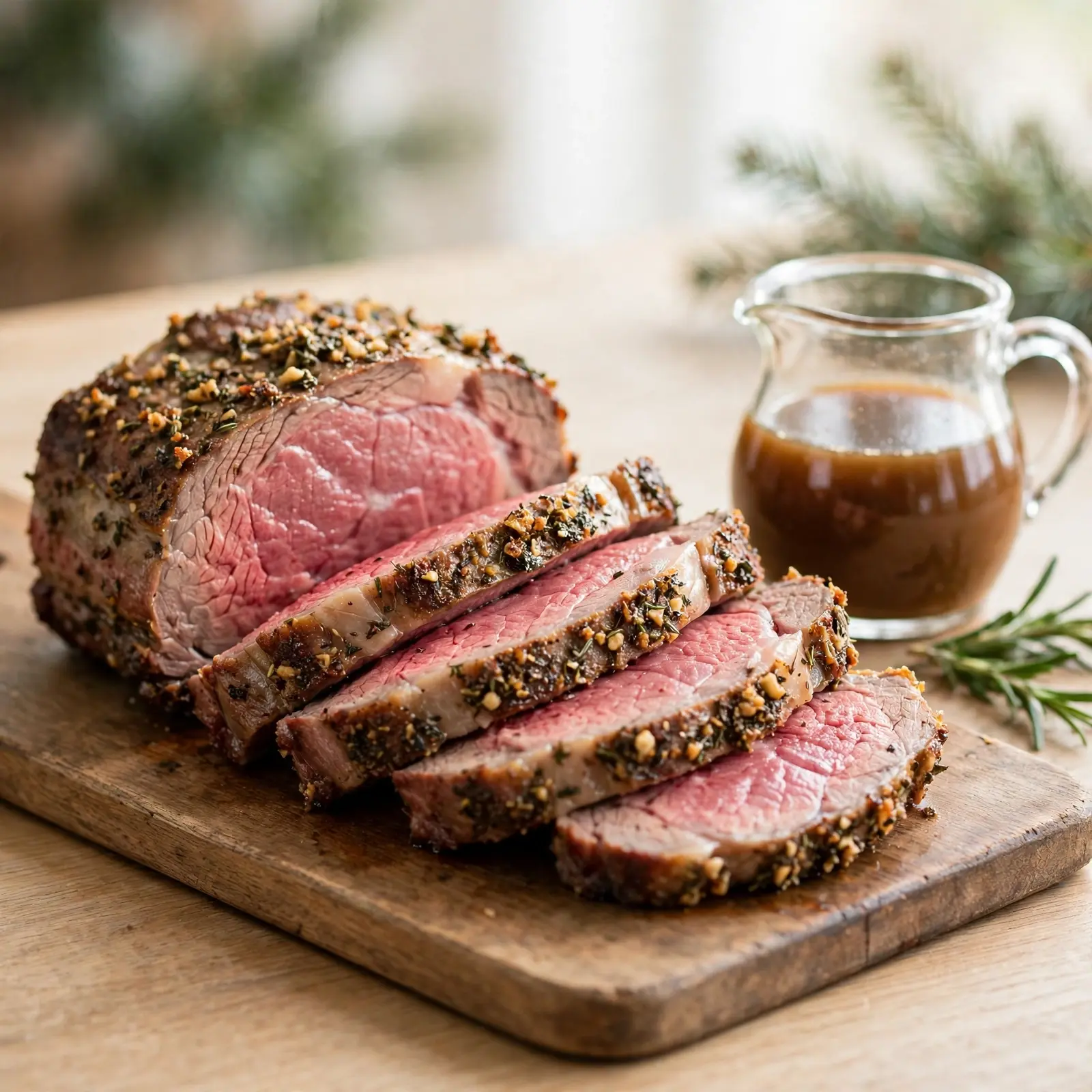
And when it goes right, it is the best plate of the year. The first slice falls open, pink from edge to edge, the garlic and rosemary crust crackles a little under the knife, and the au jus shines on every piece. Nobody talks for the first minute. That is the sound this recipe is built for.
The good news is that a small roast is not harder than a big one. It is easier, as long as you cook it the right way round: low first, hot last. That one swap, explained below, is the whole secret, and further down there is the one thermometer mistake that ruins more small roasts than any oven ever has.
Why reverse sear is the kindest method for a small roast
Most old recipes roast prime rib hot first and low after, or hot the whole way. On a big roast that works. On a small roast it punishes you, because the outside layers cook fast while the centre is still warming up, and by the time the middle is pink the outer inch has turned grey and dry.
Reverse sear flips the order. The roast sits in a gentle 225°F (110°C) oven and warms through slowly and evenly, so the whole inside reaches nearly the same temperature at the same time. Then it rests, which lets the juices settle and the temperature coast up the last few degrees. Only at the end does it meet real heat: 8 to 10 minutes at 500°F (260°C), just long enough to build a dark, crisp crust on a roast that is already cooked perfectly inside.
Two things make this method forgiving for a home cook. First, the low oven moves slowly, so a few minutes here or there barely matter; you are cooking to a temperature, not racing a clock. Second, the rest in the middle is flexible. The roast can sit tented for up to an hour while you finish the sides, and the hot blast happens right before serving, so the timing of a Christmas dinner stops being stressful.
J. ZaiB Micro-Tip: Push the thermometer probe in from the side of the roast, so the tip lands in the exact centre of the thickest part. A probe pushed down from the top almost always stops short or goes too deep, and that one wrong reading is how a small roast gets overcooked while the cook thinks everything is fine.
Doneness is two numbers, not one
Every argument about prime rib doneness comes from mixing up two different temperatures. The pull temperature is what the centre reads when the roast comes out of the low oven. The final temperature is what it reads on the board after the rest and the sear. Between the two, the temperature climbs about 10°F (5°C), because the hot outer layers keep pushing heat toward the cool centre even out of the oven. Cooks call this carryover cooking, and it is free cooking you must plan for, not a surprise.
So you always pull early, on purpose:
| Doneness | Pull from the low oven | Final after rest and sear |
|---|---|---|
| Rare | 115°F (46°C) | 125°F (52°C) |
| Medium-rare | 120°F (49°C) | 130°F (54°C) |
| Medium | 130°F (54°C) | 140°F (60°C) |
| Medium-well | 140°F (60°C) | 150°F (65°C) |
| Well done | 150°F (65°C) | 160°F (71°C) |
One honest safety note. The USDA safe minimum internal temperature for beef roasts is 145°F (63°C), followed by a rest of at least 3 minutes; you can see it on the USDA safe minimum temperature chart. Medium-rare, the way steakhouses serve prime rib, finishes at 130 to 135°F (54 to 57°C), which is below that guideline. Plenty of experienced cooks choose it on purpose for whole, intact roasts, and plenty of families prefer the official number. The table above gives you both honestly, so the choice is yours and it is an informed one.
Cooking time per pound (a guide, never a promise)
Time charts get you close; the thermometer gets you exact. Use this chart to plan your day, then trust the pull temperature in the table above. Times are for a boneless roast at fridge temperature going into a fully preheated oven, cooked to a medium-rare pull of 120°F (49°C). For rare, start checking about 15 minutes earlier; for medium, allow about 15 minutes more.
| Roast weight | At 225°F (110°C) | At 250°F (120°C) |
|---|---|---|
| 2 lb (about 900 g) | 1 hr 15 min to 1 hr 30 min | 1 hr to 1 hr 10 min |
| 3 lb (about 1.4 kg) | 1 hr 45 min to 2 hr 15 min | 1 hr 30 min to 1 hr 45 min |
| 4 lb (about 1.8 kg) | 2 hr 20 min to 2 hr 50 min | 2 hr to 2 hr 20 min |
| 5 lb (about 2.3 kg) | 2 hr 55 min to 3 hr 30 min | 2 hr 30 min to 2 hr 55 min |
| 6 lb (about 2.7 kg) | 3 hr 30 min to 4 hr | 3 hr to 3 hr 30 min |
That works out to roughly 35 to 40 minutes per pound at 225°F (110°C), and 30 to 35 minutes per pound at 250°F (120°C), for small roasts. Add the rest and the sear on top of these times when you plan serving: 30 minutes of rest and 8 to 10 minutes at 500°F (260°C).
Ingredients
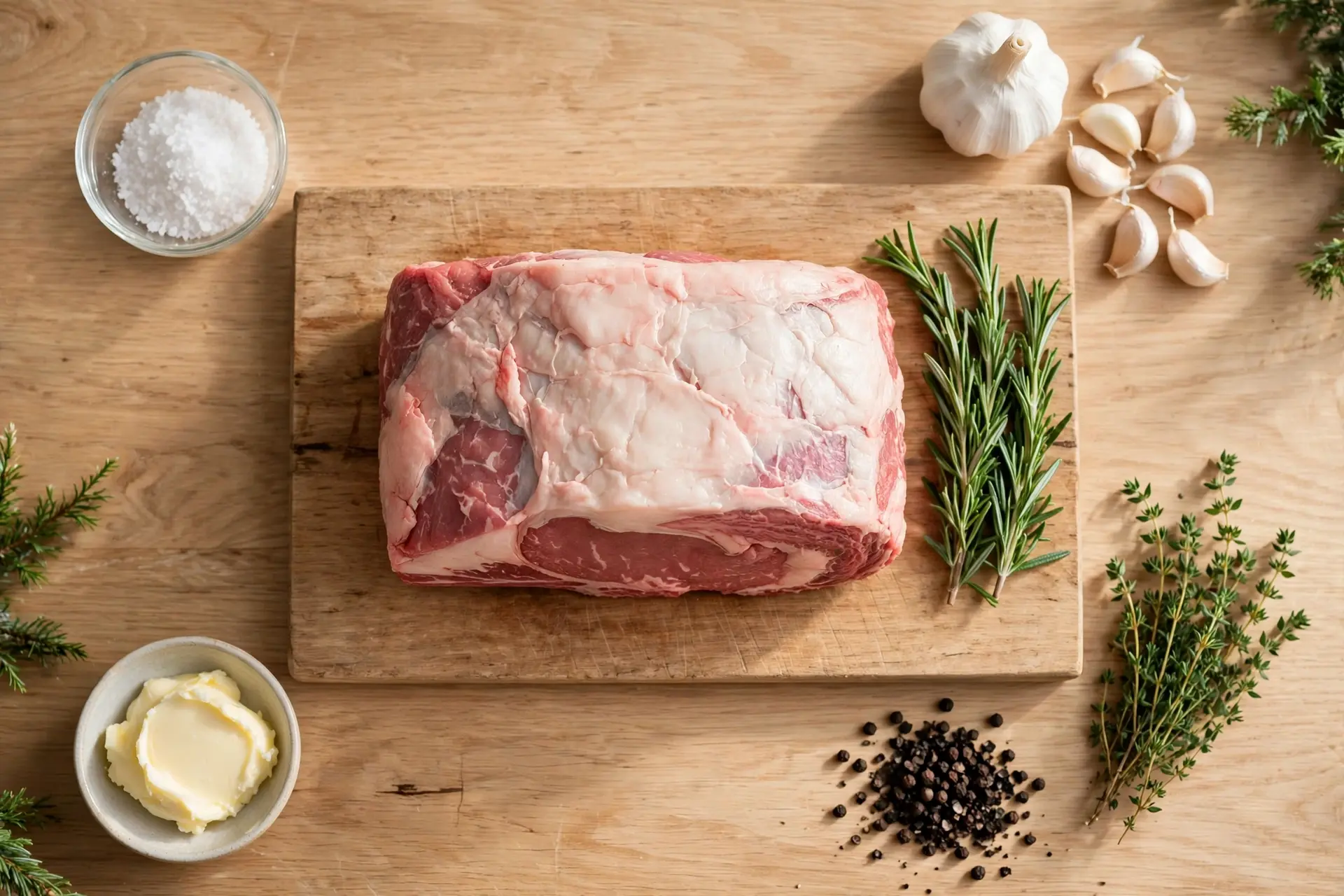
For the roast:
- 1 boneless prime rib roast (boneless ribeye roast), 3 lb (about 1.4 kg)
- 1 tablespoon (9 g) Diamond Crystal kosher salt (or 2 teaspoons Morton kosher salt)
For the garlic-herb butter rub:
- 2 tablespoons (28 g) unsalted butter, very soft
- 4 cloves garlic, minced (about 1 tablespoon)
- 1 tablespoon fresh rosemary, finely chopped (or 1 teaspoon dried rosemary)
- 2 teaspoons fresh thyme leaves (or 3/4 teaspoon dried thyme)
- 2 teaspoons freshly ground black pepper
- 1 teaspoon (3 g) garlic powder
For the au jus:
- Pan drippings from the roast
- 2 cups (480 ml) low-sodium beef stock
- 1 teaspoon Worcestershire sauce
- 1/4 cup (60 ml) dry red wine (optional)
Ingredient notes. At the shop, ask for a centre-cut boneless ribeye roast with an even shape and a fat cap about 1/4 inch thick. An even shape matters more than the grade on a small roast: a tapered, lopsided piece cooks unevenly no matter what you do, while a tidy, even one cooks like the charts say. Prime grade is a treat, Choice is excellent and costs less, and both work with this method.
Salt is the one ingredient to measure with your eyes open. Diamond Crystal kosher salt is light and flaky, so a tablespoon of it is about 9 g. Morton kosher salt is denser and saltier per spoon, which is why the recipe cuts it to 2 teaspoons. Table salt is denser still: use 1 1/2 teaspoons if that is all you have, and never a full tablespoon.
A quick word on safety. Raw beef goes back in the fridge until you are ready for it, the salted roast rests uncovered only in the fridge (never on the counter), and cooked leftovers are refrigerated within 2 hours. Wash hands, boards and knives after they touch raw meat, and use a clean board for slicing the cooked roast.
How to cook a small prime rib roast, step by step
- Salt it the day before (dry brine). Pat the roast dry with paper towels and rub the kosher salt over every surface, ends included. Set it on a rack over a plate, uncovered, in the fridge for 12 to 24 hours. The salt first draws moisture out, then pulls it back in seasoned, and the dry surface it leaves behind is what browns so well later. Short on time? Salt at least 1 hour ahead, or right before roasting; the flavour will be a little less deep, but the method still works.
- Make the garlic-herb butter. Mash the soft butter with the minced garlic, rosemary, thyme, black pepper and garlic powder until it is one fragrant paste. It should smell like a steakhouse the moment it comes together.
- Rub and tie. Take the roast out of the fridge 30 minutes before roasting. Spread the herb butter over the whole surface, then tie the roast with kitchen twine at 1 inch intervals so it holds a round, even shape (WHY: an even cylinder cooks evenly, and the thin end cannot overcook while the thick end catches up).
- Roast low and slow. Heat the oven to 225°F (110°C). Set the roast fat side up on the rack in the roasting pan and put it in, uncovered. Roast until the centre reads 120°F (49°C) for medium-rare on an instant read thermometer pushed in from the side (other doneness levels are in the table above). For the 3 lb roast this takes about 1 hour 45 minutes to 2 hours 15 minutes. Start checking 30 minutes before you expect it to finish; small roasts move quickly at the end.
- Rest it properly. Take the roast out, tent it loosely with foil, and rest it for 30 minutes. The temperature will climb about 10°F (5°C) and the juices will settle back into the meat instead of flooding the board when you slice. The roast can hold like this for up to 1 hour, which is your window to finish every side dish.
- Heat the oven for the sear. While the roast rests, turn the oven up to 500°F (260°C) and let it get fully hot. A half-hot oven gives a pale crust, so give it the full preheat.
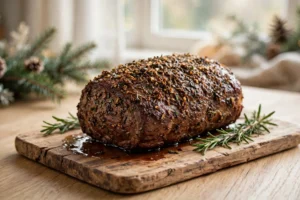
- Blast it for the crust. Put the rested roast back in the hot oven for 8 to 10 minutes, until the outside is deep brown and crisp at the edges and the herb butter is sizzling. Watch it in the last 2 minutes; at this heat the line between dark brown and burnt is short.
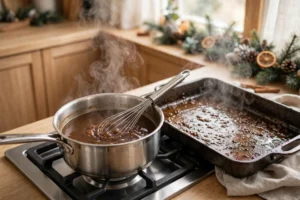
- Make the au jus. While the roast sears, pour the pan drippings into a small saucepan, keeping the browned bits and leaving most of the fat behind (or skim it). Add the beef stock, Worcestershire sauce and the wine if you are using it. Simmer for about 5 minutes, taste, and add salt only at the end (WHY: the drippings are already seasoned from the rub, and the jus reduces as it simmers, so early salt easily becomes too much). Strain it into a warm jug.
- Rest once more, briefly. Rest the seared roast for 10 minutes. This rest is short because the inside is already settled from the long rest; it just lets the crust set and the surface juices calm down.
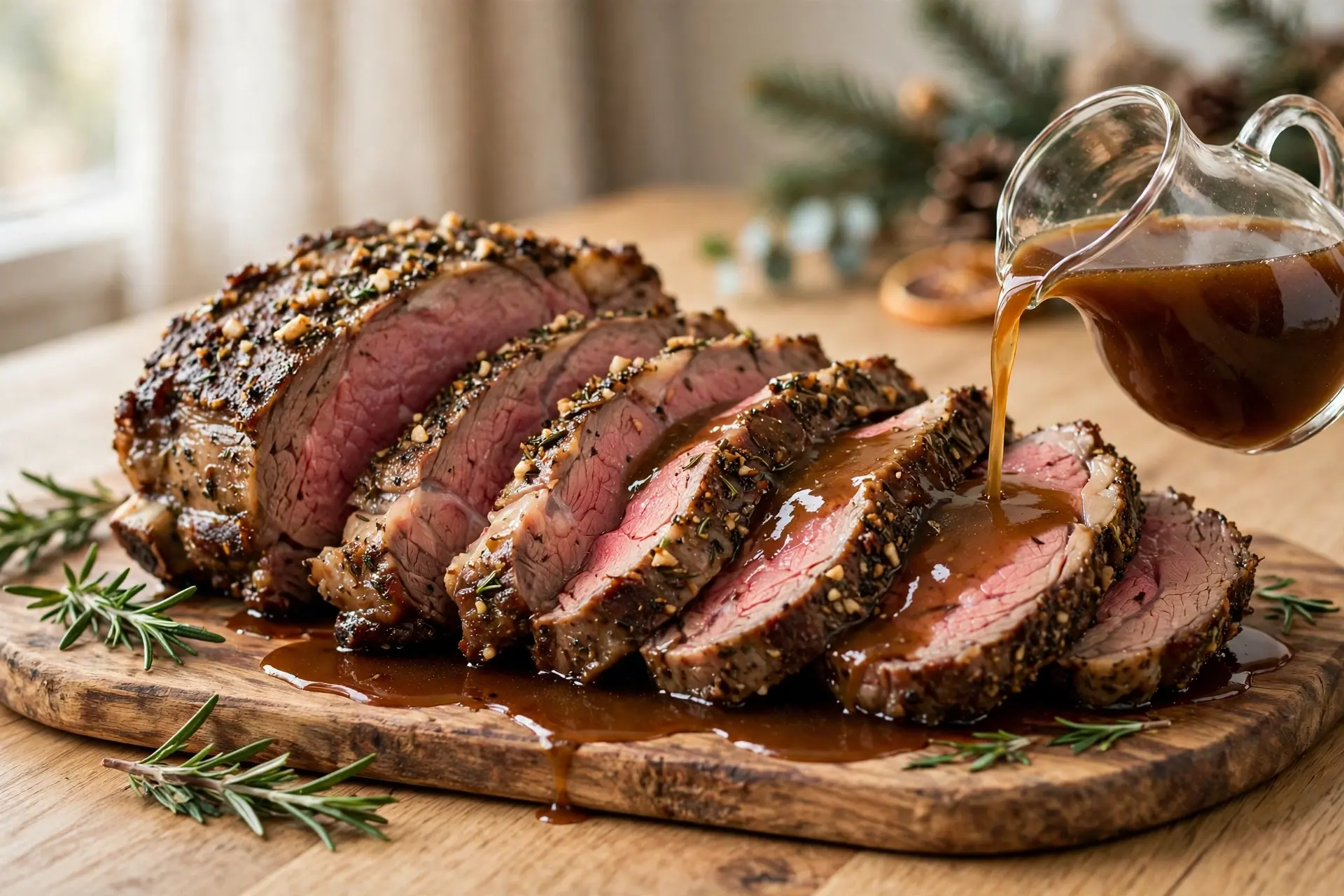
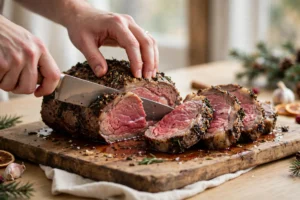
- Serve. Cut off the twine and slice the roast 1/2 to 3/4 inch thick with a sharp carving knife. Lay the slices on warm plates, spoon the hot au jus over each serving, and bring the rest of the jus to the table in its jug.
The simple au jus (from the pan drippings)
Au jus is not a gravy. There is no flour and no thickening, just the roast’s own drippings stretched with good beef stock until there is enough to spoon over every slice. It should taste like the roast itself, only more so: beefy, a little salty, with the garlic and rosemary from the crust floating through it.
Two habits keep it clean instead of greasy. First, pour the drippings into a tall jug and let the fat rise for a few minutes, then spoon the fat off the top before the stock goes in. Second, never boil it hard; a gentle simmer keeps the flavour clear. If your roast gave very few drippings, which happens with a lean piece, start the pan with a teaspoon of butter and a splash of the stock and scrape up every browned bit, because those bits are where the flavour lives.
Troubleshooting: every common problem, one fix each
| Problem | Cause | Fix |
|---|---|---|
| Grey, overcooked band under the crust | The roast started in a hot oven, or roasted hot the whole way | Reverse sear: 225°F (110°C) first, the 500°F (260°C) blast only at the end for 8 to 10 minutes |
| Centre is still cold or raw while the outside looks done | The thermometer tip was not in the exact centre, or the roast was checked too early | Push the probe in from the side into the thickest part, and cook to the pull temperature, never to the clock |
| Roast overshot its doneness during the rest | It was pulled at the final temperature instead of the pull temperature | Pull 10°F (5°C) early on purpose; carryover cooking finishes the job on the board |
| Pale, soft crust | The surface was wet, or the oven was not fully hot for the sear | Pat the roast dry before the rub goes on, and give the 500°F (260°C) preheat its full time |
| Juices flood the board when slicing | The roast was sliced too soon after cooking | Keep both rests: 30 minutes after the low roast and 10 minutes after the sear |
| Meat tastes too salty | A denser salt was measured like Diamond Crystal | Follow the brand amounts: 1 tablespoon (9 g) Diamond Crystal, 2 teaspoons Morton kosher, 1 1/2 teaspoons table salt, per 3 lb roast |
| One end is pink and the other is grey | The roast was tapered and untied | Tie with twine at 1 inch intervals so the roast holds an even, round shape |
| Au jus is greasy or bland | Fat was not skimmed, or the drippings were left in the pan | Let the fat rise in a jug and spoon it off; scrape every browned bit from the pan into the jus |
| Smoke pours out during the sear | Fat dripping from the roast onto a bare pan at 500°F (260°C) | Roast on the rack so drippings fall into the pan, and keep the pan under the roast for the sear too |
Variations worth trying
- Prime rib for two (2 lb roast). Use a 2 lb (about 900 g) boneless roast and scale the seasoning: 2 teaspoons Diamond Crystal kosher salt for the brine; for the herb butter, 1 1/2 tablespoons (21 g) butter, 3 cloves garlic, 2 teaspoons fresh rosemary, 1 teaspoon fresh thyme, 1 1/2 teaspoons black pepper and 3/4 teaspoon garlic powder. Roast at 225°F (110°C) for 1 hour 15 minutes to 1 hour 30 minutes to the same pull temperatures, rest 30 minutes, sear 8 to 10 minutes at 500°F (260°C), and make the au jus with 1 1/2 cups (360 ml) stock. It serves 2 people generously, with leftovers for sandwiches the next day, which is exactly the point of cooking prime rib for two.
- Bone-in small roast. The method and every temperature stay the same. Bones insulate the meat next to them, so allow about 5 extra minutes per pound at 225°F (110°C), and keep the thermometer tip off the bone, because bone reads hotter than meat and will fool you. Buy about 1 rib for every 2 people, and expect a 3 lb bone-in piece to feed 3 to 4.
- The high-heat start (and the 500 rule). The old method starts at 450 to 500°F (230 to 260°C) for 15 to 20 minutes, then drops to 325°F (165°C) until done. The famous 500 rule goes further: 500°F (260°C) for exactly 5 minutes per pound, then the oven is switched off and the door stays shut for 2 hours. Both work on large roasts of 5 lb and up, where the centre is far from the heat. On a small roast the hot start is what creates the grey band, and the 500 rule can overshoot because there is so little cold centre to absorb the heat. For 2 to 4 lb roasts, reverse sear is the safer pair of hands; the full answer is in the FAQ below.
How to store it (and what to do with leftovers)
Let the roast cool no longer than 2 hours, then wrap the leftovers tightly and refrigerate; sliced or whole, they keep well for 3 to 4 days. For the freezer, wrap slices in small portions with a spoonful of au jus and freeze for up to 2 to 3 months for the best quality.
Reheating without ruining it. The microwave turns prime rib grey and tough, so go gently: put the slices in a covered oven dish with a few spoonfuls of au jus and warm them at 250°F (120°C) for about 15 to 20 minutes, until just warmed through. They will not be quite as pink as the first night, but they will stay tender and juicy.
Leftover ideas worth planning for. Slice it thin and cold into sandwiches with a horseradish cream. Dice it into a breakfast hash with potatoes and a fried egg on top. Warm slices gently and lay them over a plate of creamy mashed potatoes with the leftover au jus as the sauce. Or chop the last piece small and stir it through fried rice with whatever vegetables are in the fridge.
For the Christmas table. This little roast is the centrepiece, and the rest of the day plans itself around it. The full spread, timings included, lives in our Christmas dinner guide. If your table leans sweet and glazed instead, the honey glazed ham is the other centrepiece that never disappoints, and the roast turkey covers the traditionalists. Save room at the end of the meal: a pan of cinnamon rolls with heavy cream the next morning is the cook’s reward.
Nutrition
| Nutrient | Per 1 serving (estimate) |
|---|---|
| Calories | 690 kcal |
| Carbohydrates | 1 g |
| Sugar | 0 g |
| Fat | 48 g |
| Saturated fat | 20 g |
| Protein | 62 g |
| Sodium | 720 mg |
Note: Values are estimates, calculated from the ingredient amounts for a serving of about 8 oz (225 g) of cooked roast with au jus. The exact numbers move with the fat cap on your roast and how much of it you trim at the table.
Frequently asked questions
What is the 500 rule for prime rib?
The 500 rule says: roast at 500°F (260°C) for exactly 5 minutes per pound, then turn the oven off and leave the roast inside, door shut and never opened, for 2 hours. A 3 lb roast gets 15 minutes of heat, then 2 hours of slowly falling warmth. It can work on medium and large roasts, but on a small roast the long hot start often overshoots the centre, which is why this recipe reverse sears instead and keeps the 500°F (260°C) blast for the last 8 to 10 minutes only.
Is it better to cook prime rib at 325 or 350?
Between the two, 325°F (165°C) is the safer single temperature, because it cooks more gently and gives you a wider window before the outside overcooks. At 350°F (175°C) the edges move faster and the grey band grows. For a small roast, though, both lose to the reverse sear used here: 225°F (110°C) until the centre hits the pull temperature, then a short 500°F (260°C) sear, which keeps the pink from edge to edge.
How long should I cook a 3 lb prime rib roast?
With the reverse sear in this recipe, a 3 lb boneless roast takes 1 hour 45 minutes to 2 hours 15 minutes at 225°F (110°C) to reach the medium-rare pull temperature of 120°F (49°C), then a 30 minute rest and 8 to 10 minutes at 500°F (260°C) for the crust. Start checking the centre temperature 30 minutes before the earliest time, because no two roasts are the same thickness.
How long will it take to cook a 10 lb prime rib at 225 degrees?
Plan on about 5 to 6 hours at 225°F (110°C) to a medium-rare pull of 120°F (49°C), because at that size the roast cooks at roughly 30 to 35 minutes per pound. Add the 30 minute rest and the 8 to 10 minute sear at 500°F (260°C) before serving. The thermometer still has the final word, so start checking an hour before you expect it to finish.
How long does it take to cook a 20 lb prime rib at 250 degrees?
A 20 lb roast at 250°F (120°C) needs about 8 to 10 hours to reach a medium-rare pull of 120°F (49°C). A roast that size is a whole-day project: most home ovens fit it only just, it must be at room temperature for an even start, and the pull temperature matters far more than the clock. Check the centre from the side, in the thickest part, well before the earliest estimate.
How many hours to cook a 12 lb prime rib?
At 225°F (110°C), a 12 lb roast takes about 6 to 7 hours to a medium-rare pull of 120°F (49°C), plus its rest and sear. At 250°F (120°C) it lands closer to 5 to 6 hours. Work backwards from your serving time, and remember the finished roast can hold, tented, for up to an hour, which is your safety margin.
How many will a 5 lb prime rib feed?
A 5 lb boneless roast feeds 6 to 7 people, working on about 3/4 lb (340 g) of raw meat per person. A 5 lb bone-in roast feeds 4 to 5, because the bones take up a good share of the weight. If your guests are big beef eaters or you want leftovers on purpose, plan closer to 1 lb (450 g) per person.
How many people will a 2 lb prime rib roast feed?
Two people generously, with leftovers for sandwiches, or three people with smaller servings alongside a full Christmas spread. That is why the 2 lb size is the true prime rib for two: it is the smallest roast that still slices like the real thing. The exact scaled seasoning and times for it are in the Variations section above.
Can you give me a recipe for au jus sauce for prime rib?
Yes, and it is already in this recipe. Pour the roast’s pan drippings into a saucepan, skim off most of the fat, add 2 cups (480 ml) of low-sodium beef stock, 1 teaspoon of Worcestershire sauce and an optional 1/4 cup (60 ml) of dry red wine. Simmer for about 5 minutes, strain, and salt it only at the end, because the drippings carry the seasoning from the rub. It makes about 1 1/2 cups, enough to spoon over every slice.
How far ahead should I season my prime rib?
Salt it 12 to 24 hours ahead if you can. That overnight dry brine, uncovered on a rack in the fridge, seasons the meat all the way through and dries the surface so it browns deeply. The garlic-herb butter goes on just before roasting. In a pinch, salting 1 hour ahead still helps, and salting right before roasting is acceptable; the crust will be good, just a little less seasoned in the middle.
Best Small Prime Rib Roast Recipe
Ingredients
Equipment
Method
- Pat the roast dry and rub the kosher salt over every surface. Set it on a rack over a plate, uncovered, in the fridge for 12 to 24 hours (WHY: the dry brine seasons the meat all the way through and dries the surface, so the crust browns deeply).
- Mash the soft butter with the garlic, rosemary, thyme, black pepper and garlic powder into one paste.
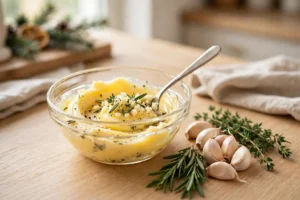
- Take the roast out 30 minutes before roasting, spread the herb butter over the whole surface, and tie it with kitchen twine at 1 inch intervals (WHY: an even, round shape cooks evenly from end to end).

- Heat the oven to 225°F (110°C). Set the roast fat side up on the rack in the roasting pan and roast, uncovered, until the centre reads 120°F (49°C) for medium-rare, about 1 hour 45 minutes to 2 hours 15 minutes for the 3 lb roast (WHY: the gentle heat cooks the roast evenly, with almost no grey band under the crust).

- Remove the roast, tent it loosely with foil, and rest it for 30 minutes, while the temperature climbs about 10°F (5°C). It can hold up to 1 hour.
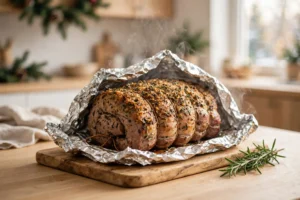
- While the roast rests, heat the oven to 500°F (260°C) and let it get fully hot.
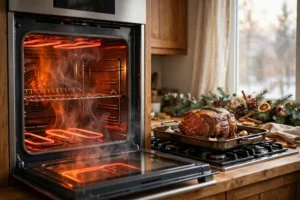
- Return the rested roast to the hot oven for 8 to 10 minutes, until the outside is deep brown and crisp at the edges.
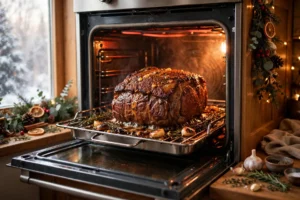
- While it sears, make the au jus: simmer the skimmed drippings with the beef stock, Worcestershire sauce and wine for about 5 minutes, then strain (WHY: salting at the end keeps the jus balanced, because the drippings already carry the rub's seasoning).
- Rest the seared roast for 10 minutes, then cut off the twine.
- Serve: slice 1/2 to 3/4 inch thick, lay the slices on warm plates, and spoon the hot au jus over each serving, with the rest in a jug at the table.
Notes
- Pull early on purpose: the centre climbs about 10°F (5°C) during the rest and sear. Pull temperatures: rare 115°F (46°C), medium-rare 120°F (49°C), medium 130°F (54°C), medium-well 140°F (60°C), well done 150°F (65°C).
- Food safety, honestly: the USDA safe minimum for beef roasts is 145°F (63°C) plus at least a 3 minute rest. Medium-rare finishes at 130 to 135°F (54 to 57°C), below that guideline; it is the common steakhouse choice for whole roasts, and the pull table lets you pick the level your family is comfortable with.
- Time is a guide, the thermometer is the rule: about 35 to 40 minutes per pound at 225°F (110°C) to a medium-rare pull for small boneless roasts; start checking 30 minutes early.
- Prime rib for two: a 2 lb (900 g) roast with 2 teaspoons salt and a scaled rub (amounts in the article) roasts in 1 hour 15 minutes to 1 hour 30 minutes and serves 2 with leftovers.
- Bone-in: same temperatures, about 5 extra minutes per pound, and keep the thermometer tip off the bone.
- Make ahead: the dry brine is the make-ahead step (12 to 24 hours). The cooked roast also holds beautifully: finish the low roast and the long rest up to 1 hour before serving, then sear and slice at the table’s pace.
- Storage: refrigerate leftovers within 2 hours; they keep 3 to 4 days in the fridge and up to 2 to 3 months in the freezer, wrapped with a spoonful of au jus.
- Reheating: slices in a covered dish with au jus at 250°F (120°C) for 15 to 20 minutes. The microwave makes prime rib grey and tough.
- UK/Australia: kosher salt is coarse cooking salt (use the gram weight, 9 g, because brands differ), and beef stock is the same name in both.