Go Back
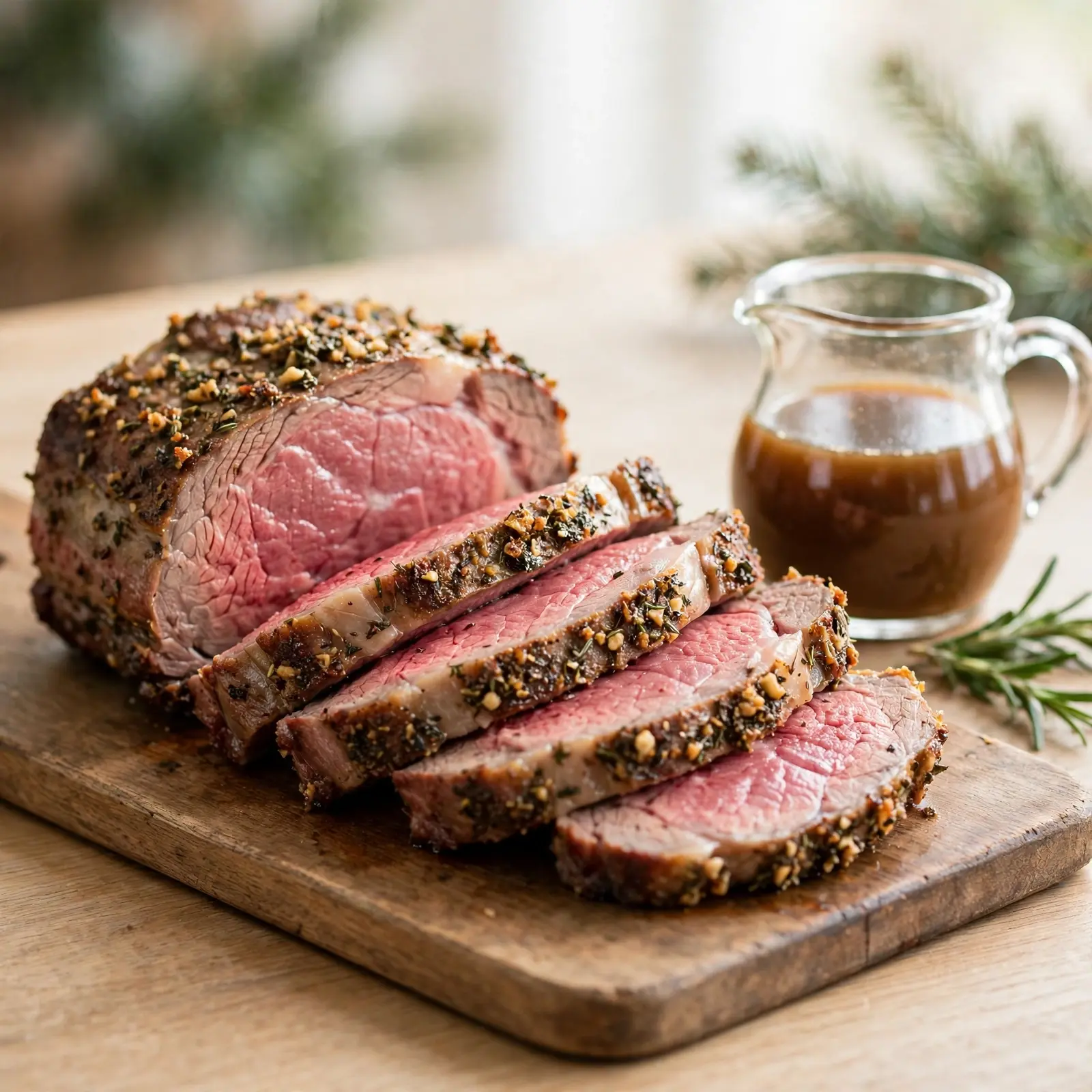
Small boneless prime rib roast sliced on a wooden board, the slices fanned open and pink from edge to edge under a dark garlic herb crust, with a small jug of au jus and fresh rosemary beside it

Best Small Prime Rib Roast Recipe

This small prime rib roast recipe gives you steakhouse slices, pink from edge to edge, from a 3 lb boneless roast that serves 4 without the big-roast price or stress. The reverse sear cooks it low and slow to the exact pull temperature, rests it, then blasts it hot for the crust, and the pan drippings become a simple au jus.
Prep Time 20 minutes
Cook Time 2 hours 15 minutes
Rest Time 40 minutes
Total Time 3 hours 15 minutes
Servings: 4 servings
Course: Dinner
Cuisine: American
Calories: 690

Ingredients
  

For the Roast
  • 1 boneless prime rib roast (boneless ribeye roast), 3 lb (about 1.4 kg) centre cut, even shape, fat cap about 1/4 inch. Substitute: a bone-in small roast works with the same temperatures, about 5 extra minutes per pound
  • 1 tablespoon Diamond Crystal kosher salt (9 g) or 2 teaspoons Morton kosher salt, it is denser and saltier per spoon; or 1 1/2 teaspoons table salt
For the Garlic-Herb Butter Rub
  • 2 tablespoons unsalted butter, very soft (28 g) salted butter works; the brine already seasons the roast, so no change needed
  • 4 cloves garlic, minced, about 1 tablespoon substitute: 1 teaspoon garlic powder, and keep the garlic powder below as well
  • 1 tablespoon fresh rosemary, finely chopped substitute: 1 teaspoon dried rosemary, crushed between your fingers
  • 2 teaspoons fresh thyme leaves substitute: 3/4 teaspoon dried thyme
  • 2 teaspoons freshly ground black pepper coarse grind holds up best in the sear
  • 1 teaspoon garlic powder (3 g)
For the Au Jus
  • Pan drippings from the roast if the roast was lean and drippings are few, start with 1 teaspoon butter and a splash of stock to scrape up the browned bits
  • 2 cups low-sodium beef stock (480 ml) low-sodium matters: the jus reduces and the drippings are already seasoned
  • 1 teaspoon Worcestershire sauce
  • 1/4 cup dry red wine (60 ml) optional; skip it and add the same amount of extra stock if you prefer

Equipment

  • 1 Roasting pan with rack The rack lifts the roast out of its drippings so the bottom cooks instead of steaming; the drippings stay in the pan for the au jus
  • 1 Instant-Read Thermometer The whole recipe runs on pull temperatures; a leave-in probe thermometer is even better because the oven door stays shut
  • 1 Kitchen Twine Ties the roast into an even cylinder so the thin end cannot overcook
  • 1 Sharp carving knife Long, thin and sharp, so the slices come off clean at 1/2 to 3/4 inch without tearing
  • 1 Large cutting board with a juice groove The groove catches the au jus and board juices instead of losing them to the counter
  • 1 Aluminum Foil For tenting the roast during both rests, loosely, never sealed tight
  • 1 Small Saucepan For the au jus; a 1 to 2 quart pan is the right size for 1 1/2 cups
  • 1 Fine mesh strainer Strains the au jus clear of herb bits and browned specks
  • 1 pair Tongs For moving the hot roast without piercing it and losing juice
  • 1 pair Oven mitts The pan comes out of a 500°F (260°C) oven; use mitts you trust, not a thin towel

Method
 

Salt and Season
  1. Pat the roast dry and rub the kosher salt over every surface. Set it on a rack over a plate, uncovered, in the fridge for 12 to 24 hours (WHY: the dry brine seasons the meat all the way through and dries the surface, so the crust browns deeply).
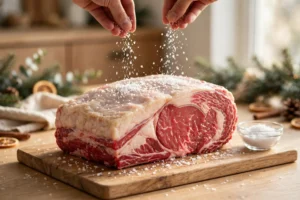
    Hands rubbing kosher salt over a boneless prime rib roast on a rack over a plate before dry brining
  2. Mash the soft butter with the garlic, rosemary, thyme, black pepper and garlic powder into one paste.
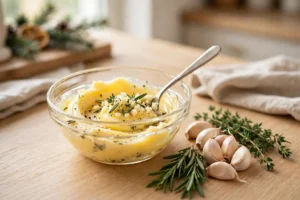
    Garlic herb butter being mixed in a bowl with minced garlic, rosemary and thyme for prime rib
  3. Take the roast out 30 minutes before roasting, spread the herb butter over the whole surface, and tie it with kitchen twine at 1 inch intervals (WHY: an even, round shape cooks evenly from end to end).
    A prime rib roast being tied with kitchen twine at regular intervals to hold an even round shape
Low and Slow
  1. Heat the oven to 225°F (110°C). Set the roast fat side up on the rack in the roasting pan and roast, uncovered, until the centre reads 120°F (49°C) for medium-rare, about 1 hour 45 minutes to 2 hours 15 minutes for the 3 lb roast (WHY: the gentle heat cooks the roast evenly, with almost no grey band under the crust).
    A small prime rib roast on a rack in a roasting pan in a low oven, roasting slowly at 225 degrees
  2. Remove the roast, tent it loosely with foil, and rest it for 30 minutes, while the temperature climbs about 10°F (5°C). It can hold up to 1 hour.
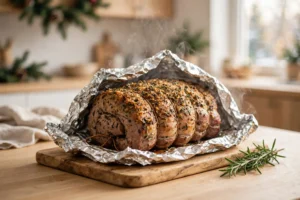
    A roasted prime rib resting on a board, tented loosely with foil
  3. While the roast rests, heat the oven to 500°F (260°C) and let it get fully hot.
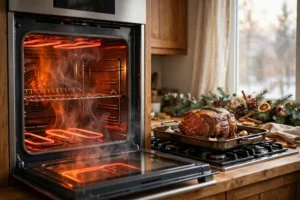
    An oven being preheated to 500 degrees for the reverse sear crust on prime rib
Sear, Slice and Serve
  1. Return the rested roast to the hot oven for 8 to 10 minutes, until the outside is deep brown and crisp at the edges.
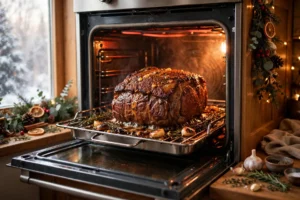
    A prime rib roast searing in a hot oven, its garlic herb crust turning deep brown and crisp
  2. While it sears, make the au jus: simmer the skimmed drippings with the beef stock, Worcestershire sauce and wine for about 5 minutes, then strain (WHY: salting at the end keeps the jus balanced, because the drippings already carry the rub's seasoning).
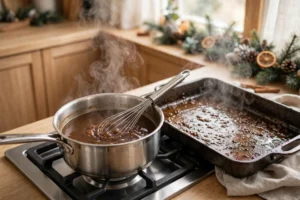
    Pan drippings being simmered with beef stock, Worcestershire sauce and red wine to make au jus
  3. Rest the seared roast for 10 minutes, then cut off the twine.
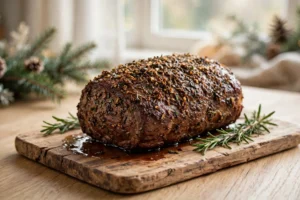
    A seared prime rib roast resting briefly on a board before slicing
  4. Serve: slice 1/2 to 3/4 inch thick, lay the slices on warm plates, and spoon the hot au jus over each serving, with the rest in a jug at the table.
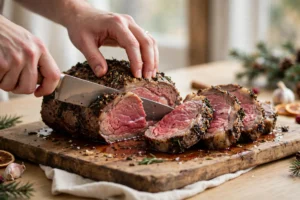
    A prime rib roast being sliced thickly on a wooden board with a sharp carving knife

Notes

  • Pull early on purpose: the centre climbs about 10°F (5°C) during the rest and sear. Pull temperatures: rare 115°F (46°C), medium-rare 120°F (49°C), medium 130°F (54°C), medium-well 140°F (60°C), well done 150°F (65°C).
  • Food safety, honestly: the USDA safe minimum for beef roasts is 145°F (63°C) plus at least a 3 minute rest. Medium-rare finishes at 130 to 135°F (54 to 57°C), below that guideline; it is the common steakhouse choice for whole roasts, and the pull table lets you pick the level your family is comfortable with.
  • Time is a guide, the thermometer is the rule: about 35 to 40 minutes per pound at 225°F (110°C) to a medium-rare pull for small boneless roasts; start checking 30 minutes early.
  • Prime rib for two: a 2 lb (900 g) roast with 2 teaspoons salt and a scaled rub (amounts in the article) roasts in 1 hour 15 minutes to 1 hour 30 minutes and serves 2 with leftovers.
  • Bone-in: same temperatures, about 5 extra minutes per pound, and keep the thermometer tip off the bone.
  • Make ahead: the dry brine is the make-ahead step (12 to 24 hours). The cooked roast also holds beautifully: finish the low roast and the long rest up to 1 hour before serving, then sear and slice at the table's pace.
  • Storage: refrigerate leftovers within 2 hours; they keep 3 to 4 days in the fridge and up to 2 to 3 months in the freezer, wrapped with a spoonful of au jus.
  • Reheating: slices in a covered dish with au jus at 250°F (120°C) for 15 to 20 minutes. The microwave makes prime rib grey and tough.
  • UK/Australia: kosher salt is coarse cooking salt (use the gram weight, 9 g, because brands differ), and beef stock is the same name in both.