

Half the people who bake it think it’s somehow a healthier dessert — and bake it accordingly, holding back on the sugar and fat. The other half treat it like a simple spice cake with orange flecks and wonder why it comes out dry and forgettable.
My first carrot cake recipe attempt was somehow both dry AND greasy at the same time. I still don’t fully understand how I pulled that off. The carrots sank to the bottom, the spices were barely noticeable, and the cream cheese frosting slid off before I could take a single photo. Three batches later, I had it figured out.
The things that changed my results were not the ones any recipe blog was talking about. It was two specific techniques nobody teaches: blooming the spices before they go into the batter, and grating the carrots in a food processor instead of a box grater.
This carrot cake recipe uses both. The result is moist, deeply spiced, and visually stunning — a cake that makes a genuine case for itself as the best one you’ll bake all year. Let’s get into it.
Why You’ll Love This Moist Carrot Cake Recipe
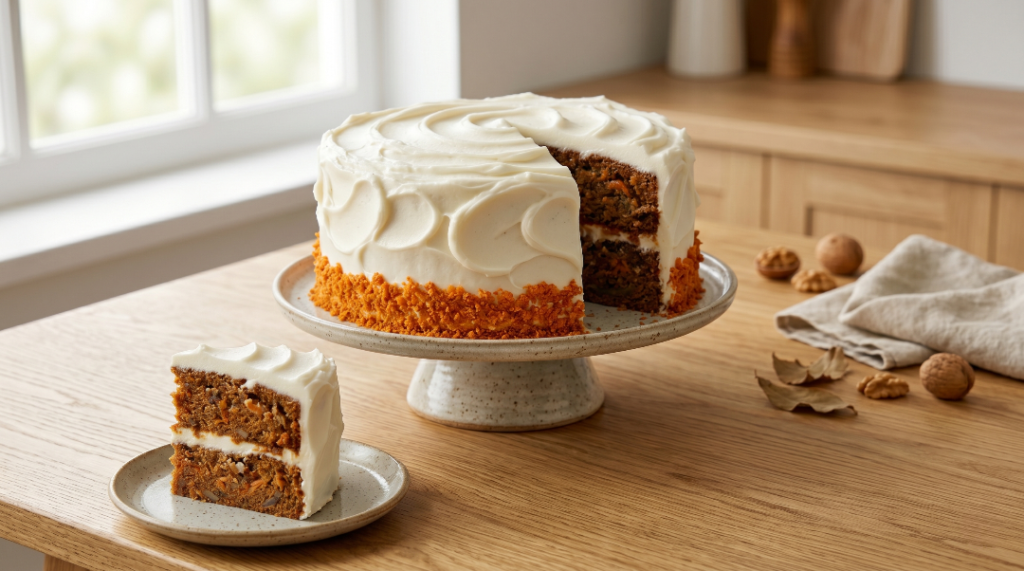
The food processor grating method changes how the carrots behave in the batter. Most recipes warn against food processors — “too chunky, too dry.” But pulsing instead of shredding gives you finely uniform pieces in 30 seconds that distribute moisture more evenly throughout the crumb than a box grater ever could. The science is in the next section.
The spice blooming technique is something most home bakers have never tried. Cinnamaldehyde — the primary flavor compound in cinnamon — is fat-soluble and heat-activated. Toasting your spices in a dry pan for 60 seconds before adding them to the batter unlocks those compounds in a way dry mixing cannot. Your kitchen will smell extraordinary. Your cake will reflect it.
This cake genuinely improves overnight. Make it the day before your party or Easter brunch. It will taste noticeably more complex the next morning — there is actual science behind this, explained below.
Cream cheese frosting that does not slide. The same cold cream cheese technique from our New York Cheesecake applies here — cold block cream cheese plus soft butter, beaten separately first. Holds for hours.
Keto and gluten-free versions included. Both are genuinely good — not consolation prizes.
The History: Carrot Cake Is Older Than You Think
Most people assume this is a 1970s health food trend. It is actually medieval.
In the Middle Ages, sweeteners were scarce and expensive. Carrots — which contain more natural sugar than most vegetables — were used as a practical sweetener substitute in puddings and baked goods. These early “carrot puddings” are the direct ancestors of the cake we know today. The modern American version took shape during World War II, when sugar rationing pushed home bakers back to vegetable-based sweetening. Carrot cake surged in popularity on both sides of the Atlantic during this period.
The cream cheese frosting pairing became standard through the 1960s and 1970s as cream cheese became widely available nationally — and the combination of warm spiced cake against cold, tangy frosting became one of the most beloved pairings in American baking. For a deeper look at the carrot’s culinary journey from ancient Persia to modern kitchens, Britannica’s overview is worth a read.
The Science: What Actually Makes This Carrot Cake Recipe Different
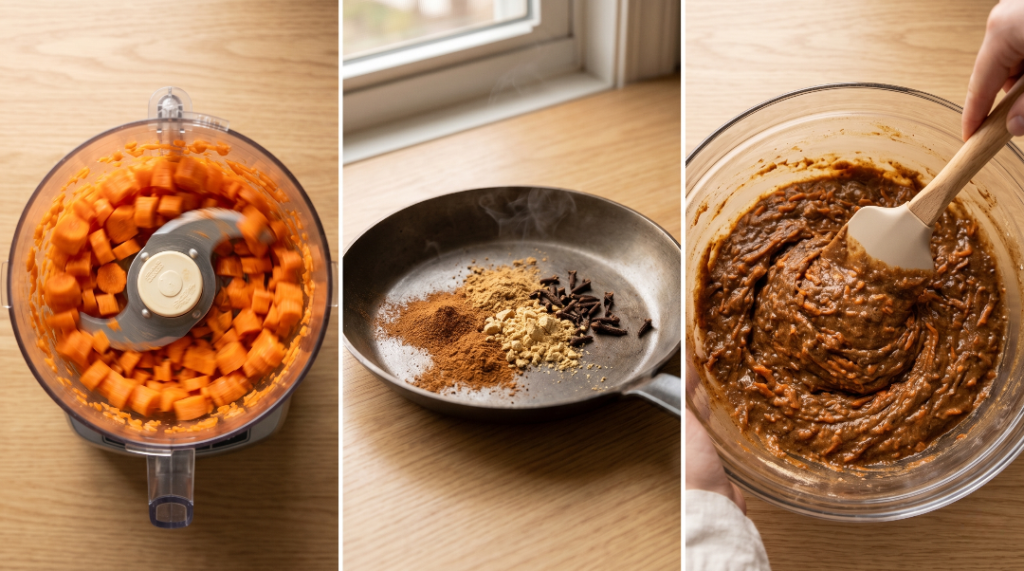
Here is what most carrot cake recipes skip — and what separates an unforgettable cake from a forgettable one.
Fresh carrots self-baste the cake from the inside. Fresh carrots contain roughly 88% water by weight. Finely grated and folded into batter, they become tiny water reservoirs that release moisture gradually during baking — self-basting the crumb from the inside out. Pre-shredded packaged carrots have lost most of this moisture during processing. No moisture release means a drier cake. This is a physical mechanism, not a preference.
Cinnamaldehyde blooms with heat. Cinnamaldehyde is the primary aromatic compound in cinnamon. It is fat-soluble and heat-activated — meaning it fully releases when exposed to heat or fat. Adding cinnamon to dry flour barely touches this potential. Toasting it in a dry pan first releases those volatile compounds before they even hit the batter. Every bite tastes more deeply spiced — not because you used more, but because you unlocked more of what was already there. For a breakdown of cinnamon compound concentrations by variety, King Arthur Baking’s spice guide explains it well.
Bromelain in pineapple tenderizes the gluten. Crushed pineapple contains bromelain — a protease enzyme that breaks down proteins, including gluten strands. When folded into carrot cake batter, it partially breaks down the gluten network — shortening those long tough strands into shorter, more tender ones. The result is a noticeably softer crumb. This is the same reason pineapple tenderizes meat in marinades. Note: bromelain is heat-sensitive and is deactivated during baking — so the tenderizing happens during mixing and the early oven period.
Molasses in brown sugar attracts moisture. Brown sugar contains molasses — a highly hygroscopic substance that actively attracts and holds water molecules from its environment. In a baked cake, this means the molasses continues pulling moisture toward itself even after baking. A cake made entirely with white sugar goes stale faster. Brown sugar is not just a flavor choice — it is a moisture retention strategy. The same principle drives our Chocolate Fudge Cake — brown sugar in the batter, noticeably longer shelf life.
Oil keeps the crumb soft at any temperature. Vegetable oil is 100% fat and stays liquid at room temperature. A slice of this carrot cake pulled cold from the refrigerator has the same tender crumb as one at room temperature. A butter-based version would feel noticeably firmer when cold — because butter solidifies. This is why oil is the professional baker’s secret for cakes that will be refrigerated and served later, as we also use in our Red Velvet Cake.
What You Need
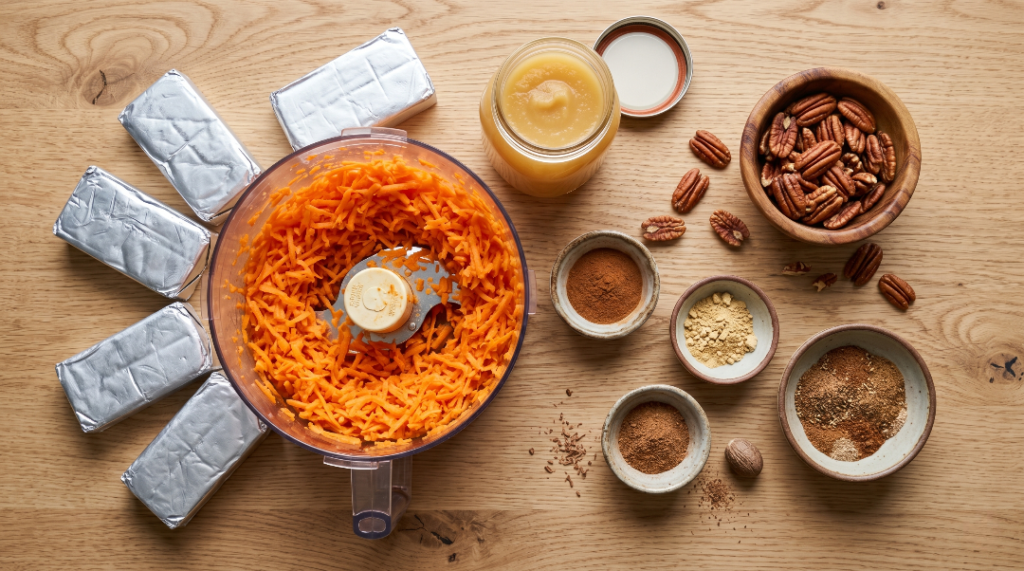
For the Carrot Cake Layers
- 2½ cups (315g) all-purpose flour (spooned and leveled)
- 2 tsp baking powder
- 1 tsp baking soda
- 1 tsp salt
- Spice Blend — bloom first (see Step 2):
- 2 tsp ground cinnamon
- 1 tsp ground ginger
- ½ tsp ground nutmeg
- ¼ tsp ground cloves
- 1 cup (200g) packed light brown sugar
- ½ cup (100g) granulated sugar
- 1 cup (240ml) vegetable oil (canola works too)
- 4 large eggs, room temperature
- ¾ cup (170g) unsweetened applesauce (or well-drained crushed pineapple)
- 2 tsp pure vanilla extract
- 3 cups (300g) freshly grated carrots (about 4 large — food processor method below)
- 1 cup (100g) chopped pecans or walnuts (optional — toast first)
- ½ cup (80g) crushed pineapple, well drained (optional — adds bromelain tenderizing)
For the Never-Melt Cream Cheese Frosting
- 16 oz (450g) full-fat block cream cheese, COLD from fridge
- 1 cup (225g) unsalted butter, softened to room temperature
- 4 cups (480g) powdered sugar, sifted
- 2 tsp pure vanilla bean paste (or vanilla extract)
- Pinch of salt
- 2 tbsp heavy cream (only if needed for thinning)
Equipment: Stand mixer or hand mixer, food processor, two 9-inch round cake pans, offset spatula Serves: 12–16 slices
How to Make the Best Carrot Cake Recipe — Step by Step
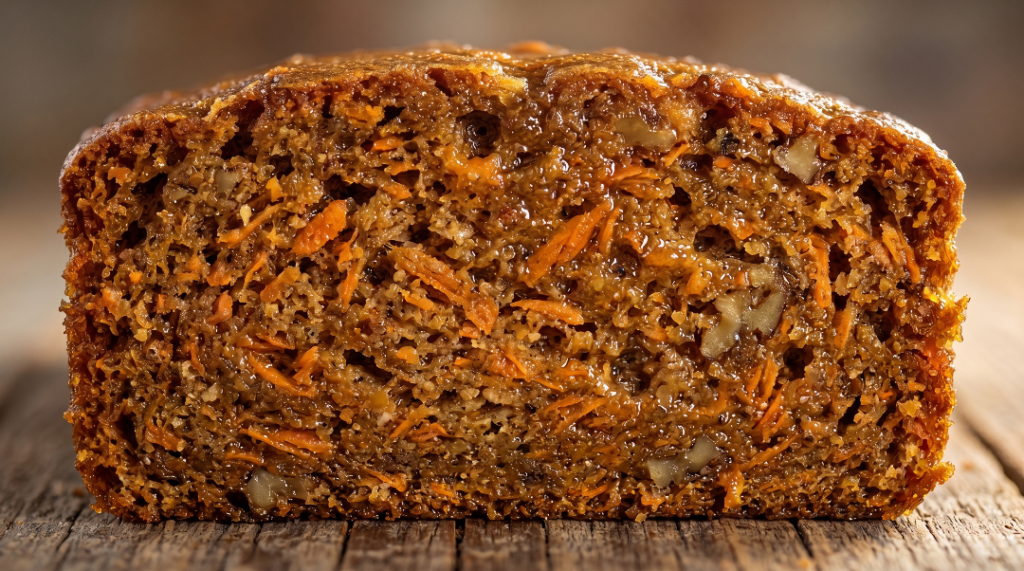
Step 1 — Prep First
Preheat oven to 350°F (175°C). Grease two 9-inch round cake pans, line with parchment, grease again. Take eggs out of the fridge 45 minutes before starting.
J.ZaiB micro-tip: Line the pans with parchment even if they are non-stick. Carrot cake’s dense, moist batter sticks more than lighter batters. Parchment guarantees clean release every time.
Step 2 — Bloom the Spices
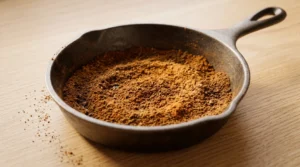
Place cinnamon, ginger, nutmeg, and cloves in a small dry pan over medium heat. Toast for exactly 60 seconds, stirring constantly, until fragrant. The smell will change noticeably — that is the volatile compounds releasing. Remove from heat immediately and add to the flour mixture in the next step.
J.ZaiB micro-tip: 60 seconds is the line. Set a timer and stir constantly. The moment the smell becomes strong — done. Over-toasted spices turn bitter and the whole effort backfires.
Step 3 — Whisk Dry Ingredients
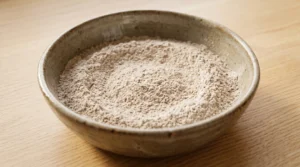
In a large bowl, whisk flour, baking powder, baking soda, salt, and the bloomed spice mixture until fully combined. Set aside.
Step 4 — The Food Processor Carrot Hack
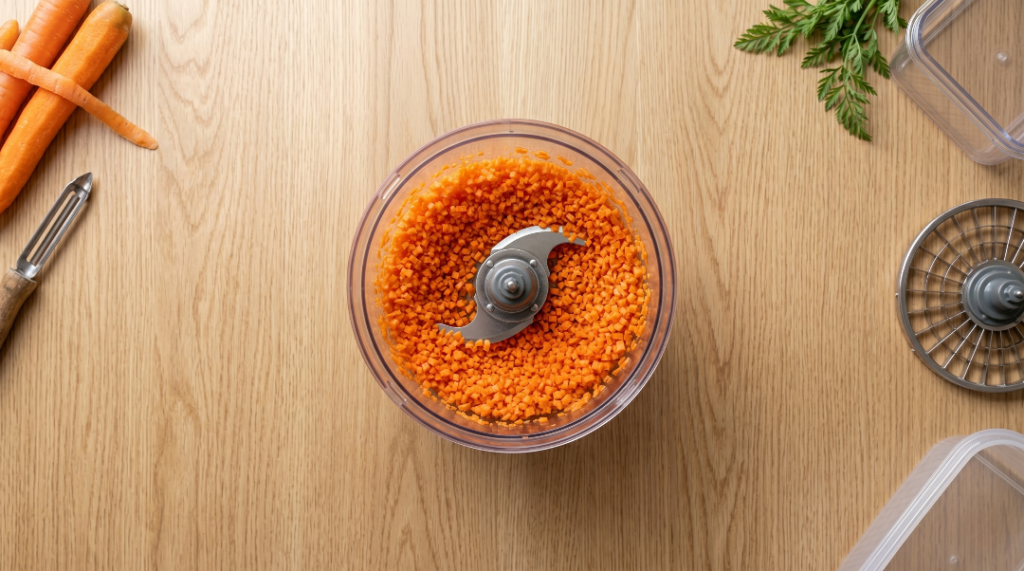
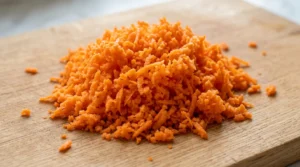
Peel carrots, cut into 2-inch chunks. Use a food processor’s grater disk for fine shreds — or use the regular blade and pulse 8–10 times until finely chopped, not pureed. You want uniform small pieces, roughly the size of coarse breadcrumbs.
Why this works: uniform, fine carrot pieces distribute evenly through the batter and release moisture at a consistent rate during baking. Box-grated carrots vary in size — some release moisture too fast, others too slow. The food processor solves the consistency problem.
J.ZaiB micro-tip: No food processor? Use the fine side of a box grater — not the coarse side. Fine shreds integrate into the batter instead of sitting in clumps. And please — no pre-shredded packaged carrots. They are partially dried and will not release the internal moisture your cake needs.
Step 5 — Make the Wet Mixture
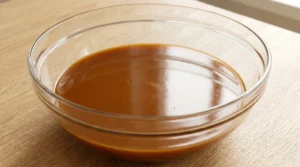
Whisk brown sugar, granulated sugar, and vegetable oil together for 1 minute. Add eggs one at a time, whisking after each. Add applesauce, vanilla, and mix until smooth.
J.ZaiB micro-tip: Adding eggs to the oil-sugar mixture before the flour lets fat coat the egg proteins before gluten forms. This is the emulsification sequence that keeps the crumb tender instead of rubbery.
Step 6 — Combine and Fold
Add dry ingredients to wet in two additions, folding gently with a spatula. Stop when you no longer see dry streaks. Fold in grated carrots, chopped nuts, and drained pineapple if using. Batter will be thick and dense — that is correct.
J.ZaiB micro-tip: Once the flour goes in, fold — never beat. Overmixing develops gluten and turns the tender carrot crumb chewy. A few lumps in the batter are fine. The carrots will hide them anyway.
Step 7 — Bake
Divide batter between the two prepared pans. Smooth the tops. Bake at 350°F for 28–35 minutes until a toothpick inserted in the center comes out with just a few moist crumbs. Begin checking at 28 minutes.
Cool in pans for 15 minutes, then turn out onto a wire rack. Cool completely — at least 2 hours — before frosting. Carrot cake retains heat longer than most cakes. Touch the center; it should feel room temperature, not warm.
J.ZaiB micro-tip: A warm cake layer will melt the cream cheese frosting on contact. Two hours feels long. Skip it and you will regret it when the frosting slides.
Step 8 — Make the Never-Melt Cream Cheese Frosting
Beat cold block cream cheese alone for 2 minutes until completely smooth. In a separate bowl, beat softened butter 3 minutes until very pale. Add butter to cream cheese and beat 1 minute together. Add sifted powdered sugar one cup at a time on low. Add vanilla bean paste and salt. Beat on medium-high 2 minutes until thick, glossy, stable.
J.ZaiB micro-tip: Cold cream cheese is non-negotiable. Room temperature cream cheese produces frosting that is too soft and slides off the cake. We use the same technique for our Red Velvet Cake and New York Cheesecake — it works the same way in all three.
Step 9 — Assemble and Frost
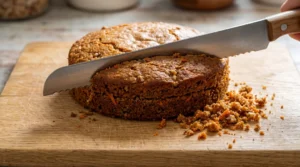
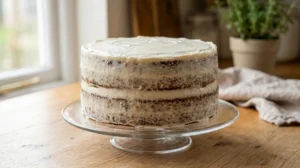
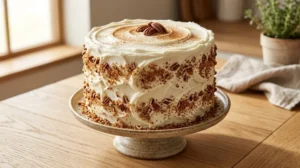
Level cooled layers with a serrated knife if domed. Save the trimmed crumbs — pressed onto the frosted sides they look stunning. Spread 1 cup of frosting between layers. Apply a thin crumb coat all over, refrigerate 15 minutes, apply final frosting. Press reserved crumbs onto sides while frosting is still tacky.
Step 10 — Garnish and Serve
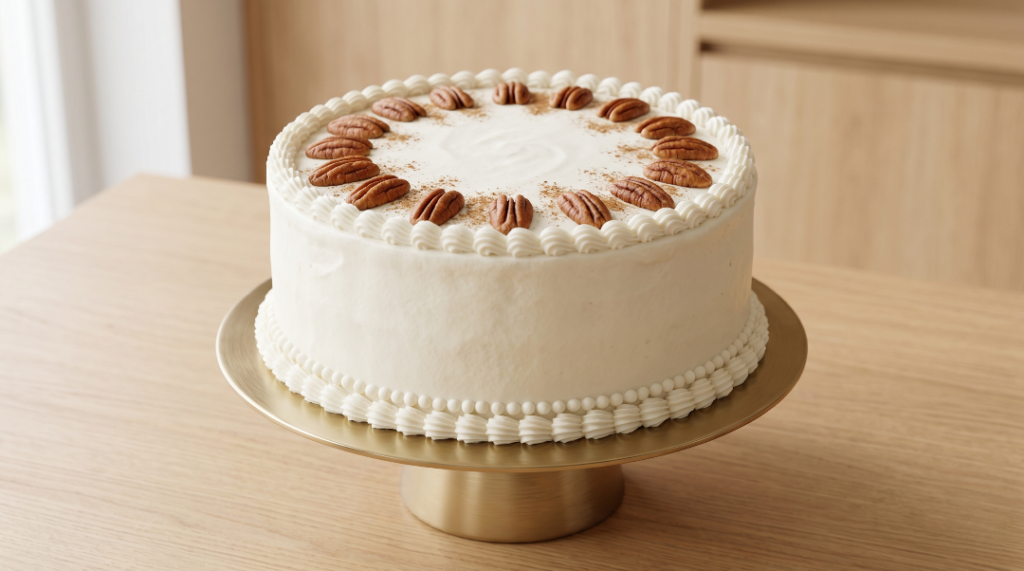
Top with toasted pecans around the edge and a sprinkle of cinnamon. For a classic presentation, pipe small marzipan carrots on top. Slice with a hot damp knife. Serve at room temperature — pull from the fridge 45 minutes before serving.
The Green Carrot Mystery — What It Is and How to Prevent It
If you cut into your carrot cake and see green-tinged carrot pieces — stop. Do not throw it out. It is safe to eat and has nothing to do with spoilage.
Baking soda is alkaline. Certain pigment compounds in carrots are pH-sensitive and change color when exposed to alkaline environments. Uneven baking soda distribution creates pockets where carrots sit in a more alkaline area and turn green.
The fix: whisk your dry ingredients thoroughly — especially the baking soda — before adding them to wet. Even distribution means consistent pH throughout the batter. No green carrots.
J.ZaiB’s Expert Touch
Bloom half the spice, add the other half raw. After testing both methods, I now split the spice quantity — bloom half in a dry pan as in Step 2, add the other half directly to the flour. The bloomed half contributes volatile, heat-released compounds. The raw half contributes raw spice backbone. The combination is more dimensional than either method alone.
Soak the carrots in pineapple juice before adding. Drain your crushed pineapple and save the juice. Toss your grated carrots in that juice and let them sit for 10 minutes. The bromelain in the juice begins tenderizing the carrot cell structure before baking. Then drain and add to the batter. Extra step, noticeable difference.
Toast the pecans before anything else. Toasted pecans have a depth of flavor that raw pecans simply do not. Spread them on a baking sheet at 350°F for 6–8 minutes before starting the cake. They toast while you prep. The upgrade in flavor is not subtle.
Make it the day before. Volatile spice compounds in cinnamon and ginger continue redistributing through the cake’s moisture overnight. The cream cheese frosting mellows and integrates with the layers. Day two is noticeably better than day one. Plan ahead when you can.
Brown sugar only if you want maximum moisture retention. The recipe uses a mix of brown and granulated. If you want to push further, replace the granulated with more brown sugar. The molasses content increases, hygroscopic moisture retention increases, shelf life increases. The flavor leans slightly more toward caramel — which works beautifully with the warm spices.
Variations to Try
Classic Sheet Cake: Pour all batter into a greased 9×13-inch pan, bake 35–40 minutes, frost directly in the pan. Maximum carrot cake for minimum effort — perfect for Easter brunch and potlucks.
Carrot Cake Cupcakes: Fill lined muffin tins ⅔ full, bake at 350°F for 18–22 minutes. Makes 24 cupcakes. Pipe generous cream cheese frosting swirls. The orange cake and white frosting on individual cupcakes is one of the most pinnable dessert photos you can take.
Pineapple Carrot Cake: Replace the applesauce entirely with ¾ cup well-drained crushed pineapple AND fold in an additional ½ cup pineapple with the carrots. Maximum bromelain effect — the softest crumb possible. If you love tropical flavor in desserts, our Moist Coconut Cake uses a similar approach to layering tropical notes into classic baking.
Gluten-Free Carrot Cake: Substitute all-purpose flour 1:1 with Bob’s Red Mill 1:1 or King Arthur Measure for Measure GF baking blend. The moist, oil-based batter is forgiving of flour substitutions. Carrot cake is one of the better recipes to convert GF — the carrots, pineapple, and applesauce provide structure that GF flours sometimes lack.
Keto Carrot Cake: Replace flour with 2 cups almond flour plus ¼ cup coconut flour. Replace both sugars with 1 cup powdered erythritol. Reduce carrots to 1½ cups to lower carb count. The cream cheese frosting is naturally keto-friendly as written.
Carrot Cake Loaf: Pour batter into a greased 9×5-inch loaf pan, bake at 350°F for 55–65 minutes. Drizzle with cream cheese glaze (cream cheese + powdered sugar + milk, thinned to pourable consistency) instead of full frosting. Great for gifting and easier to transport.
Serving Ideas
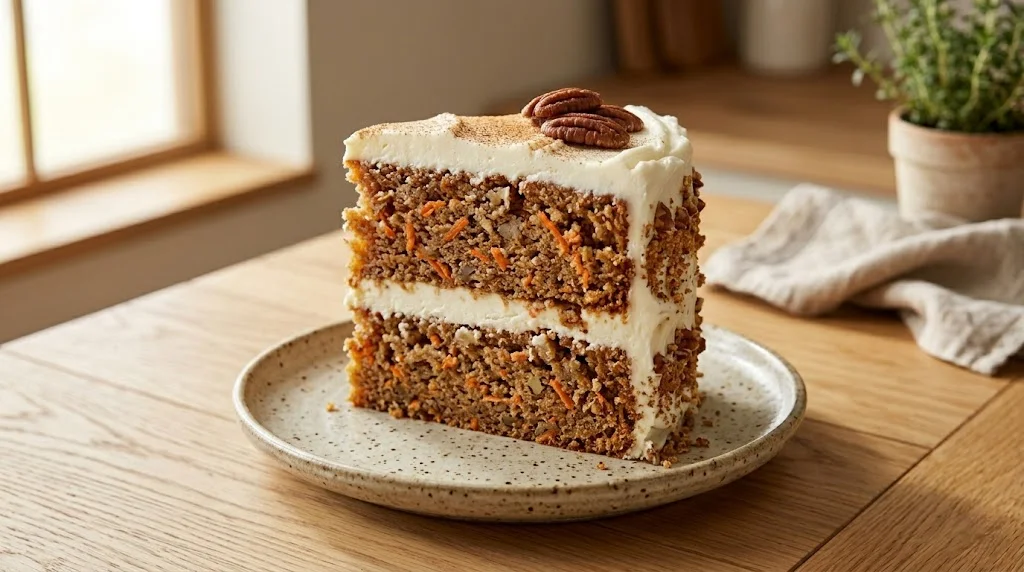
Easter brunch: The layer cake as centerpiece — orange and white color combination is naturally festive without any extra decoration. Serve alongside fresh fruit and coffee.
Birthday alternative: Carrot cake works for every age group. The tanginess of cream cheese frosting cuts the sweetness in a way that makes this cake less overwhelming than buttercream-frosted versions. People who claim they don’t like cake eat this one.
Dinner party pairing: For a complete dessert table, serve alongside our New York Cheesecake — two very different flavor profiles that complement each other without competing.
Complementary drinks: Cold brew coffee cuts through the richness of the cream cheese frosting. Dry ginger beer amplifies the ginger and nutmeg notes. Both work beautifully.
Storage & Make-Ahead Guide
Room temperature: Under a cake dome up to 2 days. The cream cheese frosting is stable at room temperature for this window.
Refrigerator: Up to 5 days tightly covered. Flavor peaks at 24–48 hours. Always bring to room temperature 45 minutes before serving — cold carrot cake is denser and less aromatic than room-temperature.
Freezer — unfrosted layers: Wrap tightly in plastic wrap and foil. Freeze up to 3 months. Thaw overnight at room temperature, still wrapped.
Freezer — frosted whole cake: Freeze uncovered 1 hour until frosting firms, then wrap tightly. Freeze up to 2 months. Thaw overnight in the refrigerator, bring to room temperature 45 minutes before serving.
Make-ahead party timeline:
- 2 days before: Bake layers, cool, wrap, refrigerate
- 1 day before: Make frosting, frost and assemble, refrigerate overnight
- Day of: Remove 45 minutes before serving, add garnishes
Best Carrot Cake Recipe (Incredibly Moist!)
Ingredients
Equipment
Method
- Preheat oven to 350°F (175°C). Grease two 9-inch round cake pans, line the bottoms with parchment paper circles, then grease the parchment. Take eggs out of the fridge at least 45 minutes before starting.

- Place cinnamon, ginger, nutmeg, and cloves in a small dry skillet over medium heat. Toast for exactly 60 seconds, stirring constantly, until fragrant. Remove from heat immediately. This releases the fat-soluble volatile compounds in the spices for a more deeply flavored cake.
- In a large bowl, whisk together flour, baking powder, baking soda, salt, and the bloomed spice mixture until fully combined. Set aside.
- Peel carrots and cut into rough 2-inch chunks. Use a food processor's grater disk for fine, uniform shreds — or use the regular blade and pulse 8–10 times until finely chopped. You want pieces roughly the size of coarse breadcrumbs — not a puree.
- In a large bowl, whisk together brown sugar, granulated sugar, and vegetable oil for 1 minute. Add eggs one at a time, whisking well after each. Add applesauce and vanilla extract, mix until smooth.
- Add dry ingredients to wet ingredients in two additions, folding gently with a spatula. Stop the moment you no longer see dry flour streaks — do not overmix. Fold in grated carrots, chopped nuts, and well-drained crushed pineapple if using. Batter will be thick and dense.
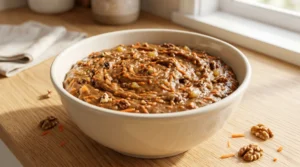
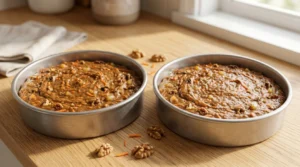
- Divide batter evenly between the two prepared pans. Smooth the tops. Bake at 350°F (175°C) for 28–35 minutes until a toothpick inserted in the center comes out with just a few moist crumbs. Begin checking at 28 minutes.
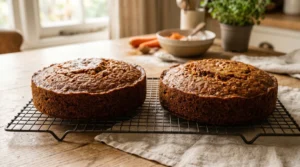
- Cool in pans for 15 minutes. Turn out onto a wire rack and cool completely — at least 2 full hours — before frosting. The center should feel room temperature, not warm.
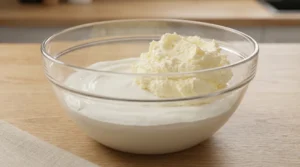
- Beat COLD block cream cheese alone for 2 minutes until completely smooth. Set aside.
- In a separate bowl, beat softened butter for 3 minutes until very pale and fluffy. Add butter to cream cheese bowl and beat together 1 minute.
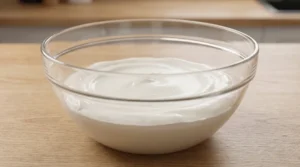
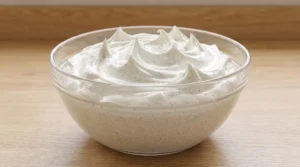
- Add sifted powdered sugar one cup at a time on low speed, beating well between each addition. Add vanilla bean paste and salt. Beat on medium-high for 2 minutes until thick, glossy, and stable. If too thick, add heavy cream 1 teaspoon at a time.
- Level the tops of cooled cake layers with a serrated knife if domed. Save trimmed crumbs for decoration.
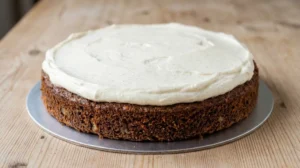
- Place one layer on a cake board. Spread 1 cup of frosting across the top. Place second layer on top, pressing gently.

- Apply a thin crumb coat of frosting all over. Refrigerate 15 minutes until firm.
- Apply the final generous frosting layer. Immediately press reserved cake crumbs onto the sides and top while frosting is still tacky. Top with toasted pecans and a light sprinkle of cinnamon.
- Slice with a sharp knife dipped in hot water and wiped dry between every cut. Remove from refrigerator 45 minutes before serving. This cake tastes noticeably better on day two — make it the day before when possible.
Notes
- Spice blooming — why and how. Toast all spices together in a dry pan for exactly 60 seconds on medium heat, stirring constantly. The heat activates cinnamaldehyde and other volatile compounds that dry mixing cannot unlock. Set a timer — over-toasting makes spices bitter.
- Food processor carrot method. Use the grater attachment for fine shreds, or pulse with the regular blade 8–10 times. Uniform fine pieces = even moisture distribution during baking. Never use pre-shredded packaged carrots — they are partially dried and produce a drier cake.
- Brown sugar is non-negotiable. The molasses in brown sugar is hygroscopic — it attracts and holds moisture. A cake made with all white sugar goes stale noticeably faster. Do not substitute.
- Block cream cheese must be COLD. Tub cream cheese has too much water content. Room temperature block cream cheese produces frosting that is too soft and slides off. Use cold, straight from the fridge.
- Green carrot pieces are safe. This is a pH reaction between alkaline baking soda and pigments in the carrots — safe to eat, does not affect flavor. Prevent it by whisking dry ingredients thoroughly for even baking soda distribution.
- Pineapple bromelain tip. Drain crushed pineapple thoroughly and save the juice. Toss grated carrots in the juice for 10 minutes before adding to batter — the bromelain enzyme begins tenderizing the carrot structure before baking. Then drain and add.
- Why it tastes better on day two. Volatile spice compounds redistribute through the cake’s moisture overnight — flavor is more fully integrated on day two. Make it the day before whenever possible.
- Toast the pecans. Spread on a baking sheet at 350°F for 6–8 minutes before starting. Toasted pecans have dramatically more flavor than raw.
- Gluten-free version. Substitute all-purpose flour 1:1 with Bob’s Red Mill 1:1 or King Arthur Measure for Measure GF baking blend. The moist oil-based batter is forgiving of flour substitutions.
- Keto version. Replace flour with 2 cups almond flour + ¼ cup coconut flour. Replace both sugars with 1 cup powdered erythritol. Reduce carrots to 1½ cups. Cream cheese frosting is naturally keto-friendly.
- UK/Australia notes. “All-purpose flour” = plain flour. “Powdered sugar” = icing sugar. “Heavy cream” = double cream. “Vegetable oil” = any neutral cooking oil.
- Storage — Room temp: Under cake dome, up to 2 days. Refrigerator: Up to 5 days tightly covered — flavor peaks at 24–48 hours. Bring to room temperature 45 min before serving. Freezer (unfrosted layers): Wrapped tightly, up to 3 months. Freezer (frosted): Freeze uncovered 1 hour until frosting firms, wrap tightly, up to 2 months.
- Nutrition values are estimates. Use a nutrition calculator with your exact brands for precise figures.
NUTRITION
(Per 1 slice — based on 14 slices, with frosting and pecans)
| Nutrient | Amount |
|---|---|
| Calories | ~545 kcal |
| Total Fat | 32g |
| Saturated Fat | 14g |
| Cholesterol | 95mg |
| Sodium | 380mg |
| Total Carbs | 62g |
| Sugars | 48g |
| Fiber | 2g |
| Protein | 6g |
Note:
Values are estimates. Actual values vary based on exact ingredients, slice size, and frosting amount. Use a nutrition calculator with your exact brands for precise figures.
Frequently Asked Questions
Why did my carrot cake turn green inside?
Green carrot pieces happen when baking soda — which is alkaline — reacts with pH-sensitive pigments in the carrots. It is completely safe to eat and does not affect flavor. To prevent it, whisk your dry ingredients very thoroughly so baking soda distributes evenly through the entire batter.
Can I use a food processor to grate carrots for carrot cake?
Yes — and in most cases it produces better results than a box grater. Use the grater attachment for fine shreds, or the regular blade pulsed 8–10 times until finely chopped. Uniform, fine carrot pieces distribute more evenly through the batter and release moisture more consistently during baking.
Why does carrot cake taste better the next day?
Volatile spice compounds — particularly cinnamaldehyde in cinnamon and gingerol in ginger — continue redistributing through the cake’s moisture overnight. This flavor migration integrates the spice notes throughout every bite. The cream cheese frosting also mellows and melds with the cake layers during the chill time.
Does pineapple make carrot cake more moist?
Yes — for two reasons. It adds direct moisture, and it contains bromelain, a protease enzyme that breaks down gluten proteins in the flour and creates a noticeably softer crumb. Drain it well before adding to control the overall liquid balance.
Can I make carrot cake without nuts?
Absolutely — omit the pecans or walnuts with no other changes. The cake will be slightly less textured but equally moist and flavorful. Finely shredded coconut makes a good texture substitute if you want something in that role.
How do I keep carrot cake moist for days?
Use vegetable oil instead of butter, use brown sugar, add applesauce or pineapple, and store the frosted cake refrigerated. The cream cheese frosting seals moisture at the cut edges. Always bring to room temperature before serving for the best texture.
Can I make this gluten-free?
Yes — substitute all-purpose flour 1:1 with a quality GF baking blend. The dense, moist, oil-based batter is forgiving of flour substitutions. Check that your baking powder is certified gluten-free.
What is the difference between carrot cake and spice cake?
Carrot cake contains grated fresh carrots as a primary ingredient — they add moisture, natural sweetness, texture, and the characteristic orange flecks. Spice cake relies entirely on dry spices without any vegetable component. Carrot cake is also typically denser and more moist than spice cake, which tends toward a lighter, airier crumb.
The Cake That Converts Everyone
Every kitchen deserves a carrot cake recipe worth keeping — one that earns the right to appear at birthdays, Easter tables, and dinner parties without explanation or apology.
The spice blooming technique, the food processor carrot method, the bromelain tenderizing from pineapple, the never-melt cream cheese frosting — each element of this recipe exists because it produces a measurably better result. Not tradition. Not convention. Science and testing.
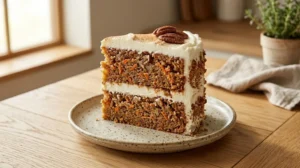
Make it the day before if you can. Let it rest overnight. Pull it out 45 minutes before serving. Slice with a hot knife and let the layers do the talking — orange carrot crumb, white cream cheese frosting, moist all the way through.
Tag us on Instagram @viralfoodhacks706 when yours is done — I especially love seeing the cross-section shots! Save this to Pinterest for Easter, birthdays, or any occasion that deserves a cake worth making.