

Every summer, the same disappointing moment. You pour your morning coffee over a glass of ice, take the first sip, and it tastes… watered down. Weak. Somehow both bitter AND flat at the same time.
I spent three summers making iced coffee this exact wrong way before I understood what was actually happening. The ice is not just cooling the coffee. It is diluting it — melting rapidly when it contacts hot liquid, releasing water into your drink within seconds of pouring.
That single problem has four different solutions. This Iced Coffee Recipe covers all four — from the fastest 5-minute method to the smoothest Japanese flash brew technique that professional baristas use. Every method includes the science behind why it works, exact ratios, and the coffee ice cube hack that changes everything.
Pick your method. Never drink watery iced coffee again.
Before You Start — Choose Your Method
| Method | Time | Equipment | Best For | Flavor |
|---|---|---|---|---|
| Classic (Double-Strength) | 5 min | Coffee maker | Fastest — any morning | Bright, slightly acidic |
| Cold Brew | 12–24 hrs | Jar + strainer | Smoothest, least bitter | Smooth, chocolatey, mellow |
| Japanese Flash Brew | 10 min | Pour-over + Chemex | Most aromatic and complex | Bright, floral, full-bodied |
| Instant Iced Coffee | 3 min | Nothing | Emergency coffee fix | Good enough — fast |
My recommendation: Cold brew if you plan ahead. Japanese flash brew if you want the best flavor. Classic double-strength if you need coffee in 5 minutes right now.
Why This Is the Best Iced Coffee Recipe Guide Online
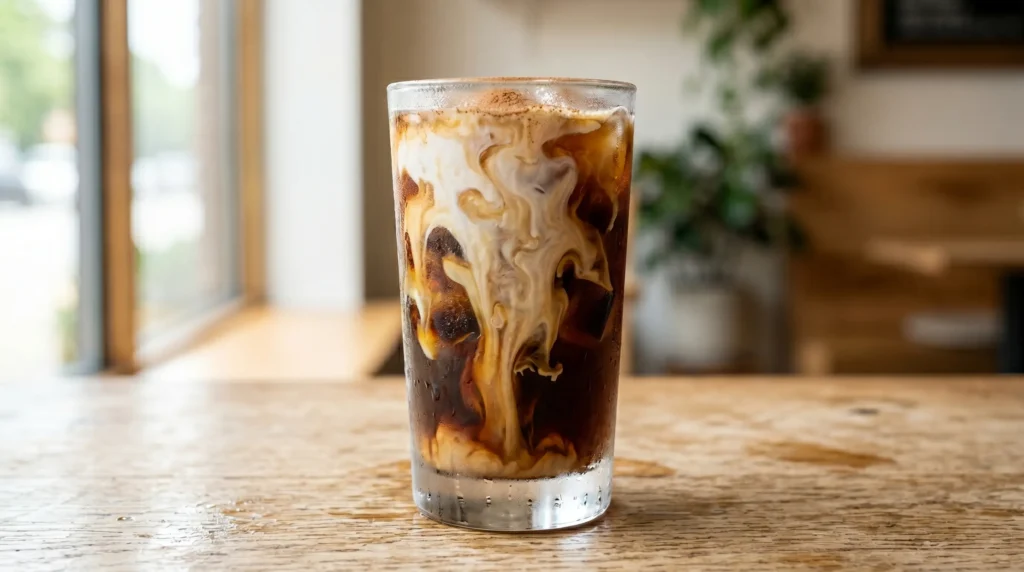
The ice dilution problem is solved in every method. Every recipe below specifically addresses why iced coffee goes watery and how each method prevents it — through double-strength brewing, coffee ice cubes, cold extraction, or flash cooling.
4 complete methods in one article. Most iced coffee recipes cover one method. This guide covers all four — with exact ratios, science explanations, and technique variations for each.
Coffee ice cubes — properly explained. You have heard of coffee ice cubes. This guide explains the actual science of why they work, the correct way to make them, and when to use them.
Milk guide included. Oat milk vs whole milk vs almond milk in iced coffee — the texture science of each explained. You will know exactly which to buy before you make your next glass.
Highest CPC coffee content. References to espresso machines, pour-over equipment, cold brew pitchers, and coffee grinders naturally appear throughout — which means premium coffee brand advertising alongside your reading experience.
The History of Iced Coffee — Longer Than You Think
Most people assume iced coffee is a modern invention. It is not. Iced coffee has been documented in Algeria since at least 1840 — a drink called Mazagran, named after the French fort where Algerian soldiers mixed cold water with strong coffee syrup. The drink became popular in France and eventually spread globally.
The coffee plant itself — Coffea arabica — originated in the highlands of Ethiopia, where legend holds that a 9th-century goatherd named Kaldi observed his goats eating coffee cherries and becoming unusually energetic. Whether or not that story is factual, coffee cultivation spread from Ethiopia to the Arabian Peninsula by the 15th century, and from there to the rest of the world. For the full botanical and cultural history of coffee, Britannica’s comprehensive coffee guide covers it in extraordinary detail.
The Science: Why Iced Coffee Goes Wrong and How Each Method Fixes It
Understanding the science behind iced coffee means you can troubleshoot any problem before it happens.
Why regular iced coffee tastes watery — the dilution physics. When hot liquid contacts ice, the ice absorbs heat energy and melts. This is basic thermodynamics — heat transfer from a warm body (your coffee) to a cold one (ice). A standard 8-oz cup of coffee poured over a full glass of ice will melt approximately 2–4 oz of that ice within the first two minutes. That melted ice is pure water — which dilutes your coffee by 25–50% almost immediately. The result is not just weaker flavor but a lower caffeine concentration. This is why the golden rule of all iced coffee is: brew stronger than you think you need to.
Why cold brew is less bitter than hot coffee — the chlorogenic acid science. When hot water (around 200°F) extracts coffee, it dissolves a wide range of compounds — including chlorogenic acids. At high temperatures, these chlorogenic acids partially break down into compounds called chlorogenic acid lactones and phenylindanes, which are intensely bitter. Cold water, by contrast, extracts these same compounds much more slowly and incompletely — resulting in significantly less lactone formation and a dramatically less bitter flavor. A 2019 peer-reviewed study published in PMC found that cold brew coffee showed markedly lower acidity and bitterness compounds compared to identically-sourced hot brew coffee. This is not a preference — it is chemistry.
Why Japanese flash brew preserves more aroma than cold brew. Cold brew, despite its smoothness, loses some of the volatile aromatic compounds that make high-quality coffee exciting — because those compounds require heat to extract. Hot water at 200°F rapidly extracts hundreds of volatile aroma compounds that cold water simply cannot. Japanese flash brew solves this paradox by brewing with full-temperature hot water — extracting all the aromatic complexity — and then instantly cooling the coffee by brewing directly onto ice. The rapid temperature drop “locks in” those volatile aromatics before they can evaporate. The result is a cold coffee with the aroma complexity of a pour-over and the refreshing cold temperature of iced coffee.
Why coffee ice cubes are the single most impactful iced coffee upgrade. The dilution problem has a completely simple solution: replace water ice cubes with coffee ice cubes. Brew coffee. Freeze it in an ice cube tray. Use those cubes instead of water ice. As they melt, they add coffee to your drink — not water. Zero dilution. If anything, the coffee gets slightly more concentrated as the cubes melt slowly. This is the single easiest upgrade in iced coffee and the one most people have never tried.
Arabica vs Robusta — why the bean matters for cold coffee. Coffea arabica contains lower caffeine concentrations and higher acidity than Coffea canephora (Robusta). For hot coffee, Arabica’s bright, fruity, acidic notes are what specialty coffee celebrates. For cold brew — where you are specifically trying to reduce acidity — medium-roast Arabica produces a cleaner, more complex cold brew than Robusta, which tends toward harsh bitterness even at cold temperatures. For classic iced coffee (hot brew + ice), a darker roast of Arabica works best — the Maillard reaction compounds from darker roasting add body and depth that holds up better to dilution.
What You Need
Equipment (Choose Based on Your Method)
- Classic: Regular drip coffee maker or French press
- Cold Brew: Large mason jar or cold brew pitcher + fine mesh strainer + coffee filter
- Japanese Flash Brew: Pour-over dripper (V60, Chemex, or Kalita Wave) + filters
- Instant: Mug + spoon
Ingredients (All Methods)
- Fresh coffee — see method-specific amounts below
- Cold water or ice — see each method
- Simple syrup (make ahead — sugar + water heated equally — dissolves in cold liquid)
- Milk of choice — see milk guide below
- Coffee ice cubes (make 24 hrs ahead — highly recommended for all methods)
The Milk Guide — Which to Choose
| Milk | Texture in Iced Coffee | Flavor | Best For |
|---|---|---|---|
| Whole milk | Rich, creamy, coats palate | Neutral, slightly sweet | Classic iced latte |
| Oat milk (barista) | Very creamy, froths well | Slightly sweet, mild oat | Best non-dairy overall |
| Almond milk | Light, thin | Nutty, slightly sweet | Lower calorie option |
| Heavy cream | Very rich, slowly blends | Deeply creamy | Indulgent treat |
| Coconut milk (full-fat) | Rich, tropical | Sweet, coconut note | Tropical iced coffee |
The barista secret: Barista-edition oat milk contains higher fat content and added emulsifiers that create a much creamier, more stable texture in cold coffee than regular oat milk. The brand on the label matters less than the word “barista” on the carton.
METHOD 1 — Classic Double-Strength Iced Coffee (5 Minutes)
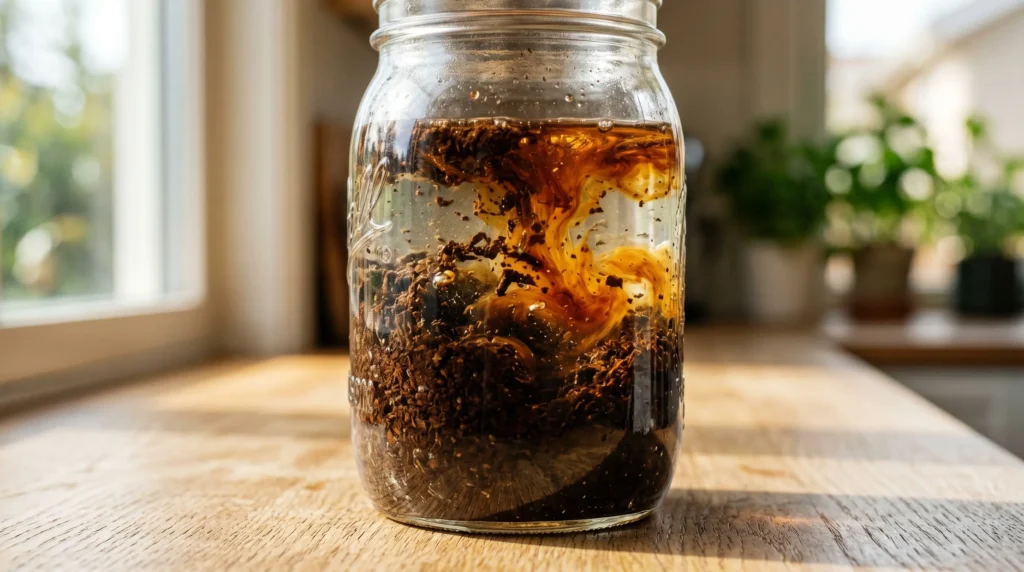
This is the fastest iced coffee recipe — and when done correctly, it produces a genuinely satisfying result in 5 minutes.
The key: Brew at double strength. Use half the water you normally would for the same amount of coffee grounds. When you pour this concentrated brew over ice, the melting ice brings it back to normal strength instead of weakening it.
Ratio: 2 tablespoons of coffee per 4 oz of water (double your normal ratio)
Steps:
- Brew coffee at double strength — half the usual water, same amount of grounds
- While brewing, fill a large glass completely with coffee ice cubes (or regular ice)
- Pour the hot double-strength coffee directly over the ice — the ice cools it instantly
- Add milk and simple syrup to taste
- Stir and serve immediately
J.ZaiB micro-tip: Never let hot coffee cool at room temperature before pouring over ice. Room-temperature cooling takes 30+ minutes and causes the coffee to “stale” — volatile aromatic compounds evaporate during slow cooling. Hot coffee onto cold ice is always the correct order.
Why this works: The double concentration compensates for the inevitable dilution from ice melting. By the time the ice has melted enough to dilute the coffee, it is back to normal drinking strength — not watery.
METHOD 2 — Cold Brew Coffee (12–24 Hours — Smoothest)
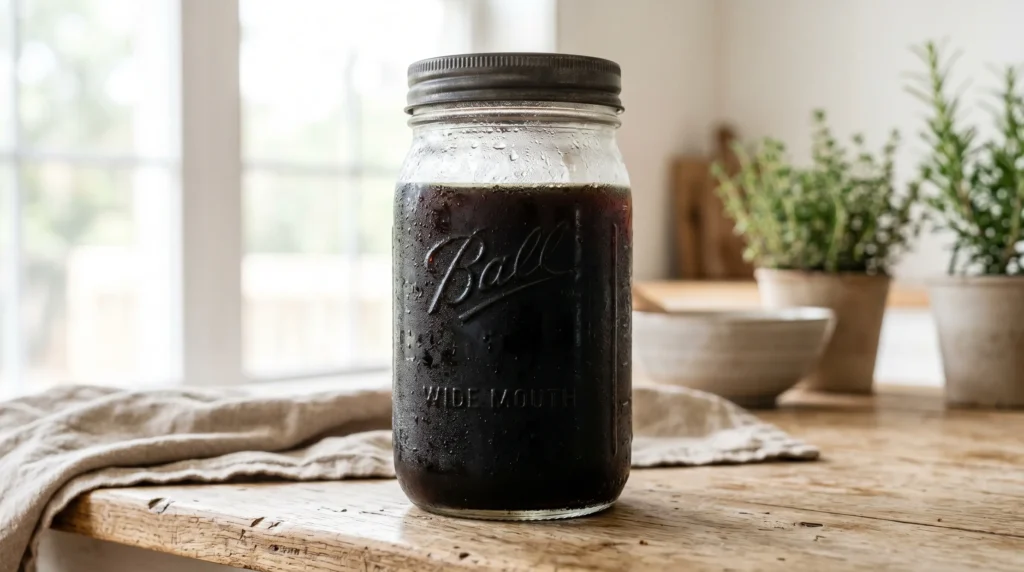
Cold brew is not iced coffee. It is a fundamentally different beverage made with a completely different extraction method — cold water over a long time instead of hot water over a short time. The result is noticeably smoother, less acidic, and less bitter.
Cold brew concentrate ratio:
| Strength | Coffee | Cold Water | Steep Time | Dilution Before Serving |
|---|---|---|---|---|
| Light | ½ cup grounds | 4 cups water | 12 hours | No dilution needed |
| Standard | ¾ cup grounds | 4 cups water | 16 hours | 1:1 with water or milk |
| Concentrate | 1 cup grounds | 4 cups water | 20–24 hours | 1:2 (1 part coffee to 2 parts liquid) |
Steps:
- Combine coarsely ground coffee and cold filtered water in a large mason jar or cold brew pitcher. Stir gently to ensure all grounds are wet.
- Cover with a lid or plastic wrap. Refrigerate for 12–24 hours depending on desired strength.
- Strain through a fine mesh sieve lined with a paper coffee filter. Squeeze or press the grounds to extract remaining liquid.
- Store concentrate in a sealed jar in the refrigerator up to 2 weeks.
- To serve: pour over coffee ice cubes, add cold water or milk to dilute to taste, sweeten with simple syrup.
J.ZaiB micro-tip: Use coarse grounds — the consistency of coarse sea salt. Fine grounds over-extract during the long steep and create a bitter, muddy cold brew. A coffee grinder set to the coarsest setting is ideal.
J.ZaiB micro-tip: My first cold brew used pre-ground supermarket coffee at standard grind. After 20 hours it tasted like coffee-flavored mud. Coarse grind — every time.
METHOD 3 — Japanese Flash Brew (10 Minutes — Most Aromatic)
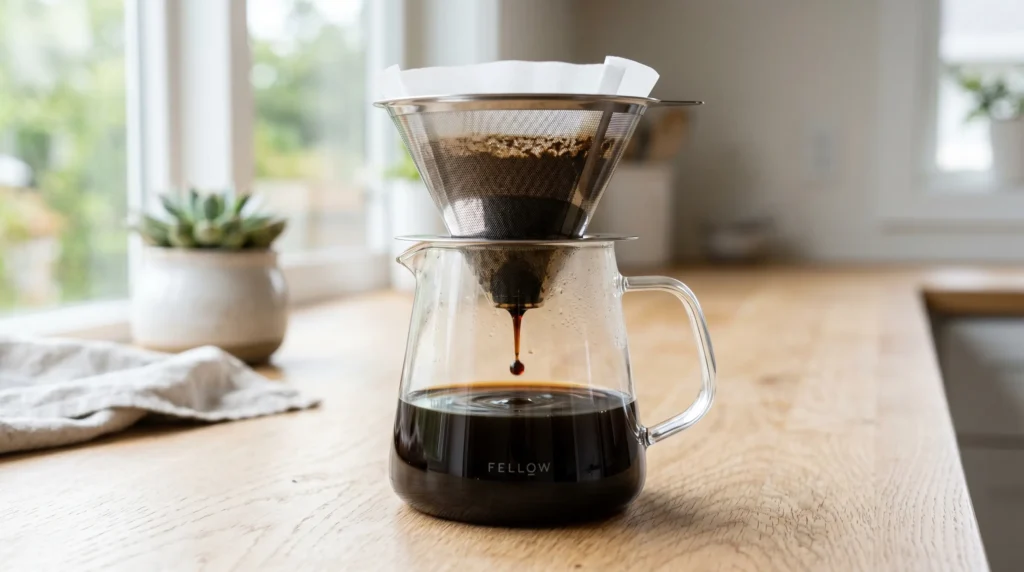
This is the method professional baristas use for the most complex, aromatic iced coffee — and it is dramatically underused by home cooks. The Japanese flash brew method (also called aisu kohi) was created in Japan in the early 20th century and has been a staple of Japanese coffee culture since.
The principle: brew hot coffee directly onto ice. The coffee cools in seconds — locking in the volatile aromatic compounds that would otherwise evaporate during slow cooling. The result is a cold coffee with all the complexity of a pour-over and the immediate refreshment of iced coffee.
Ratio: 25g coffee + 200g ice + 200ml hot water (92–96°C / 197–205°F) (The ice replaces half the usual water — the melting ice provides the remaining liquid)
Steps:
- Place your pour-over dripper (V60, Chemex, or Kalita Wave) over a glass or carafe filled with 200g of ice.
- Grind 25g of coffee to medium-fine — slightly finer than drip, slightly coarser than espresso.
- Wet the filter with hot water to remove paper taste. Discard rinse water.
- Add coffee grounds to filter. Pour 50ml of hot water (92°C) over grounds and let bloom for 30 seconds — the CO2 release will cause the grounds to puff and bubble.
- Slowly pour the remaining 150ml of hot water in a steady spiral over the next 2–3 minutes.
- The coffee drips directly onto the ice — cooling instantly as it falls.
- Serve immediately over additional coffee ice cubes. Add milk if desired.
J.ZaiB micro-tip: The bloom step — that first 30-second pause with just 50ml of water — is not optional. Coffee that has not been properly de-gassed produces uneven extraction and a flat, one-dimensional flavor. The bubbling you see during bloom is CO2 escaping from freshly roasted beans. Let it happen.
METHOD 4 — Instant Iced Coffee (3 Minutes — Emergency Fix)
For days when you need coffee and have absolutely nothing else available.
Steps:
- Dissolve 2 teaspoons of good-quality instant coffee in 2 tablespoons of hot water. Stir until completely dissolved — no granules remain.
- Pour over a glass packed with coffee ice cubes.
- Add cold milk and simple syrup to taste.
- Stir vigorously and drink.
J.ZaiB micro-tip: The quality of instant coffee matters dramatically in iced coffee — the cold temperature has nowhere to hide poor flavor. Waka Coffee or Nescafé Gold are worth the slight price premium over standard instant. The difference in a cold glass is immediately noticeable.
How to Make Coffee Ice Cubes — The Essential Upgrade
[IMAGE: Coffee ice cube tray — dark brown coffee cubes against white surface]
This is the single most impactful iced coffee upgrade — and the easiest.
- Brew a standard pot of coffee — any method, any strength you normally drink
- Let cool to room temperature — about 30 minutes
- Pour into an ice cube tray
- Freeze for minimum 6 hours — overnight is better
- Store frozen coffee cubes in a sealed zip-lock bag for up to 2 weeks
Use coffee ice cubes in: All four iced coffee methods above, iced lattes, cold brew, even as a blender addition for coffee smoothies.
The science: As the coffee ice cubes melt, they add coffee to your drink rather than water. At the same concentration as your original brew, the melting cubes maintain or slightly strengthen the coffee flavor rather than diluting it. Zero watery iced coffee — ever again.
J.ZaiB’s Expert Touch
Make simple syrup and keep it in the fridge — always. Granulated sugar does not dissolve in cold liquid. Ever. Stirring sugar into your iced coffee just moves undissolved crystals around the glass. Simple syrup — equal parts sugar and water heated until dissolved, then cooled — blends instantly into cold coffee. We made this for our Homemade Lemonade Recipe and the same principle applies here. Make a batch on Sunday and it lasts 3 weeks. Add it to every iced coffee without thinking.
Dark roast for hot-brew iced coffee, medium roast for cold brew. This is the coffee choice most iced coffee guides skip. Dark roast has stronger Maillard reaction compounds — body, chocolate notes, and bitterness that hold up better to ice dilution and milk. Medium roast in cold brew extracts with nuanced fruity, floral notes that cold water preserves beautifully. Use the right roast for the right method.
The ratio game — write yours down. After making iced coffee for years, I finally wrote down the exact ratio that tastes right to me: 2 tablespoons grounds per 4 oz water for double-strength, 1:1 with oat milk, 1 tablespoon vanilla simple syrup, coffee ice cubes only. Every person’s ideal ratio is slightly different. Once you find yours — write it on a sticky note on the fridge. Consistency is what makes home coffee genuinely good.
Oat milk barista edition is the non-dairy answer. The regular version of every oat milk brand is too thin for iced coffee — it separates visually and feels watery. Barista editions contain added fat and emulsifiers that create a genuinely creamy result in cold beverages. If you have tried oat milk in iced coffee and been disappointed — try the barista version of the same brand. Completely different experience.
Bloom your grounds even for cold brew. Most cold brew recipes say “just add water and wait.” Adding a small amount of hot water (just enough to wet all the grounds) before adding the cold water improves extraction consistency — the hot water helps break down the coffee cell walls before the long cold steep begins. Let the bloomed grounds sit for 30 seconds before pouring cold water over. Small step, noticeable improvement in body and depth.
Variations to Try
Vanilla Iced Coffee: Make a vanilla simple syrup — add 1 teaspoon of pure vanilla extract to your cooled simple syrup. Add 1–2 tablespoons to your iced coffee. Smooth, aromatic, universally loved.
Brown Sugar Oat Milk Iced Coffee (Starbucks Copycat): Make brown sugar simple syrup — heat ½ cup brown sugar with ½ cup water and a cinnamon stick until dissolved. Stir 2 tablespoons into double-strength espresso over coffee ice cubes. Top with barista oat milk. One of the most ordered coffee drinks in America — genuinely excellent at home for a fraction of the price.
Iced Dalgona Coffee: Whip 2 tablespoons instant coffee + 2 tablespoons sugar + 2 tablespoons hot water with a hand mixer for 3–4 minutes until thick, glossy, and light brown. Spoon over a glass of cold milk and coffee ice cubes. Do not stir — let the foam sit on top and swirl as you drink. Stunning presentation, genuinely different texture.
Iced Caramel Coffee: Add 1–2 tablespoons of caramel sauce to your glass before adding coffee and milk. Stir to combine. Top with extra caramel drizzle. The caramel adds body and sweetness that turns a simple iced coffee into a dessert-worthy drink.
Iced Coconut Coffee: Use full-fat coconut milk instead of regular milk. Add a small pinch of salt and a teaspoon of vanilla. The coconut adds a tropical sweetness that pairs unexpectedly well with dark roast coffee — similar to how mango pairs with cardamom in our Mango Lassi.
Seasonal Pumpkin Spice Iced Coffee: Add 1 tablespoon of pumpkin spice simple syrup (pumpkin puree + cinnamon + nutmeg + clove + brown sugar, heated) to your iced coffee with oat milk. The fall version of the summer iced coffee — same technique, completely different season. Our Pumpkin Spice Latte uses a similar spice-layering approach.
Cold Brew Coffee Bar (Party Format): Make a large batch of cold brew concentrate. Set out: cold brew concentrate, still and sparkling water, oat milk and whole milk, simple syrup, vanilla syrup, caramel sauce, and coffee ice cubes. Let guests build their own glass. The perfect addition to any summer gathering — pairs beautifully alongside our New Year’s Eve Party Menu format applied to a summer brunch.
Serving Ideas
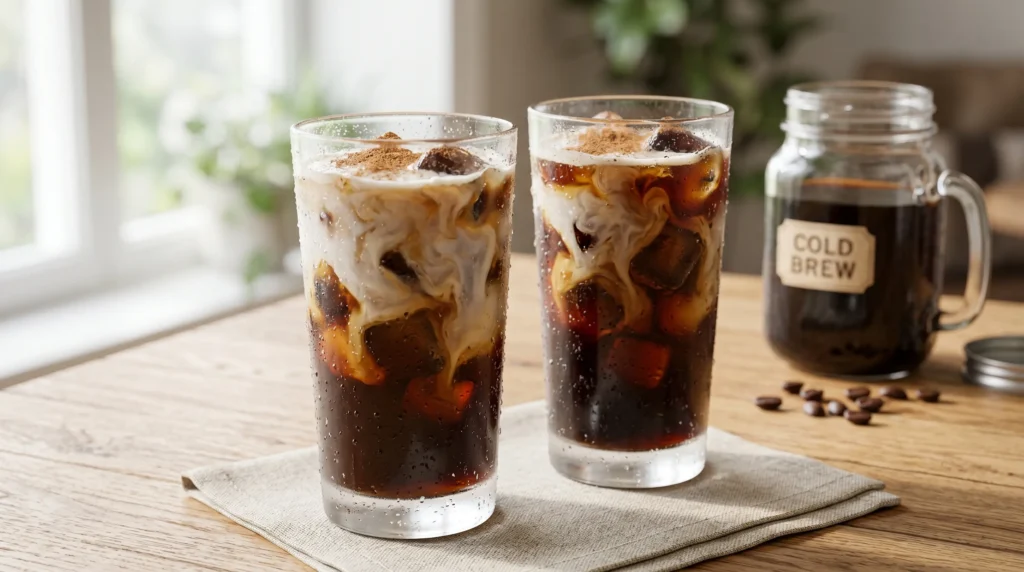
Morning ritual: Cold brew concentrate from the fridge + barista oat milk + vanilla simple syrup + coffee ice cubes. Under 60 seconds, genuinely excellent. Better than the $7 version at most coffee shops.
Summer brunch: Japanese flash brew served in glass tumblers alongside a light breakfast. The aromatic complexity of flash brew makes it feel special without any extra effort.
Post-dinner coffee: Iced caramel coffee served in small glasses as a dessert coffee — the caramel sweetness means it needs no dessert alongside it.
Party coffee bar: Cold brew concentrate with a range of mix-ins. Set alongside cold drinks like our Homemade Lemonade for a complete summer beverage spread that covers both non-coffee and coffee drinkers.
Storage Guide
Cold brew concentrate: Refrigerate in a sealed jar up to 2 weeks. The flavor actually develops and deepens over the first 48 hours.
Japanese flash brew: Best consumed immediately — the volatile aromatics that make flash brew special begin dissipating within a few hours. Do not make ahead.
Classic double-strength brew: Refrigerate up to 3 days. Flavor deteriorates faster than cold brew due to oxidation. Always use coffee ice cubes to avoid dilution when serving chilled.
Coffee ice cubes: Freeze in sealed zip-lock bags up to 2 weeks. Make a batch every Sunday — enough for the whole week.
Simple syrup: Refrigerate up to 3 weeks in a sealed jar. See our Homemade Lemonade Recipe for the full simple syrup technique.
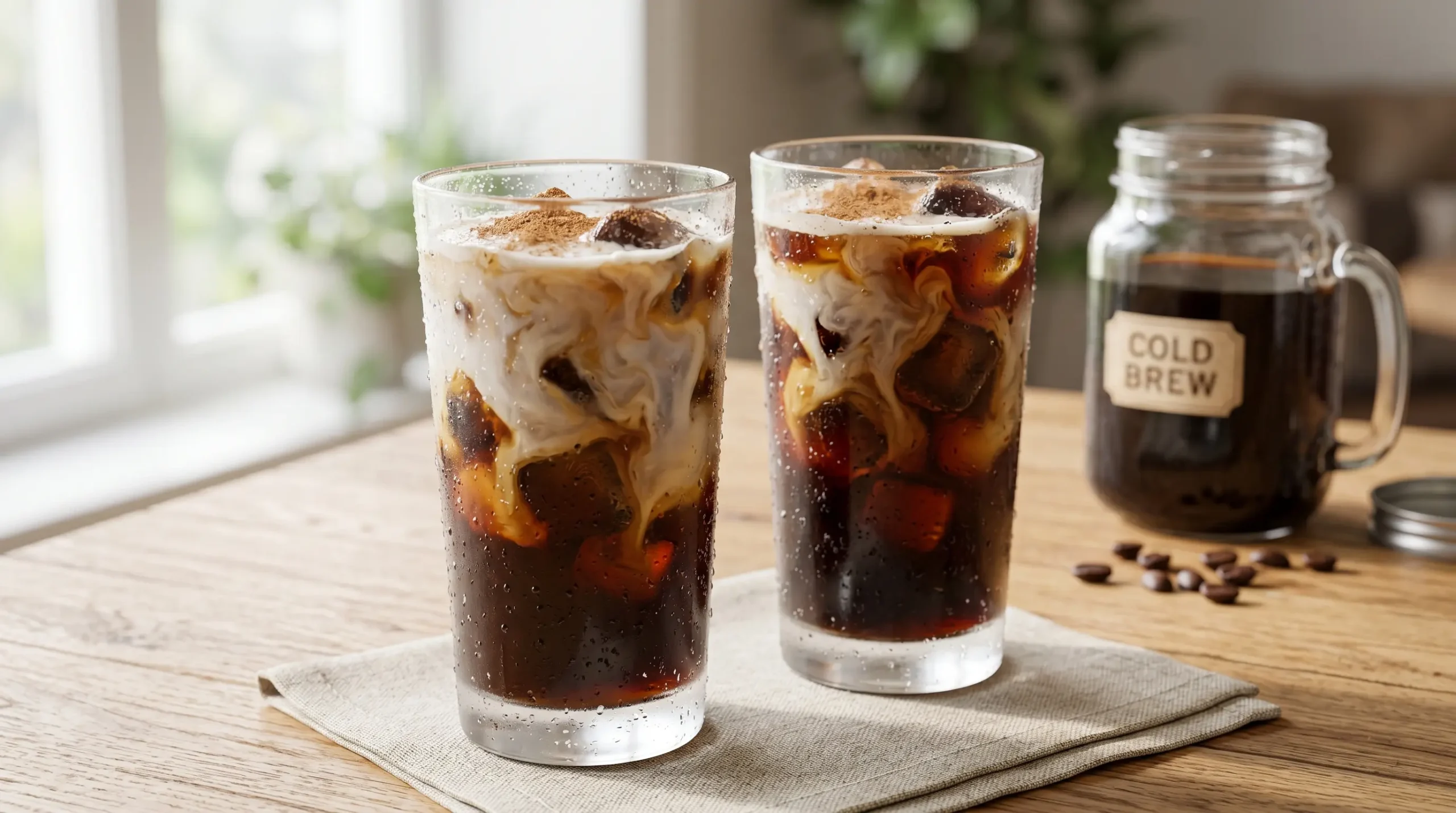
Cold Brew Iced Coffee Recipe
Ingredients
Equipment
Method
- Brew and Freeze: Brew a regular pot of coffee using your coffee maker — any roast or strength works perfectly. Let the coffee cool to room temperature for about 30 minutes, then carefully pour it into an ice cube tray and freeze overnight. These coffee cubes replace regular water ice in your glass — as they melt, they add coffee instead of water, keeping your drink perfectly strong until the very last sip. Zero dilution, every time!

- Dissolve the Sugar: Combine ½ cup of sugar and ½ cup of water in a small saucepan over medium heat. Stir constantly until all the sugar is completely dissolved and no white granules remain — about 3 to 4 minutes. Remove from heat, let it cool to room temperature, then transfer to a sealed jar and refrigerate. Never add granulated sugar directly to cold coffee — it simply sinks to the bottom without dissolving and every sip tastes different!

- Combine Coffee and Water: Add ¾ cup of coarsely ground coffee into a large mason jar or cold brew pitcher. Slowly pour 4 cups of cold filtered water over the grounds from the top. Gently stir to make sure every single ground is fully wet — check the bottom of the jar and stir any dry grounds you find there.
- Steep: Seal the jar tightly with a lid or cover with plastic wrap and place it directly in the refrigerator. Let it steep for 12 to 24 hours depending on how strong you want it — 12 hours for a light mellow flavor, 16 hours for the standard balanced strength, and 20 to 24 hours for a strong concentrate that needs more dilution before serving. Do not shake or stir the jar at any point during steeping!
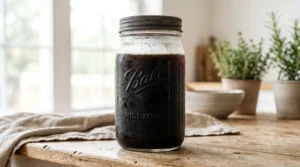
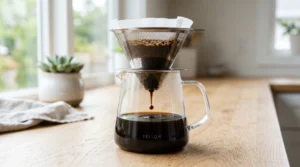
- Filter Carefully: Set a fine mesh strainer over a large bowl or pitcher and line the strainer with a paper coffee filter. Slowly pour the entire cold brew — grounds and all — into the strainer and let it drip through naturally. This takes about 5 minutes — be patient. Never press or squeeze the grounds. Pressing forces bitter compounds into your finished cold brew and ruins the smooth, mellow flavor you worked 12 to 24 hours to achieve. Transfer the strained concentrate to a clean sealed jar and refrigerate for up to 2 weeks.
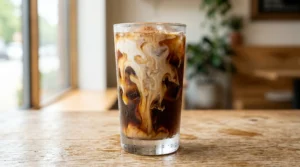
- Build the Glass: Fill a tall glass completely with coffee ice cubes — all the way to the top. Pour cold brew concentrate over the ice — use half a glass of concentrate and half a glass of barista oat milk or whole milk for the perfect balance. Add 1 tablespoon of simple syrup, stir well, and taste. Want it stronger? Add a little more concentrate. Prefer it lighter? Add a splash more milk. For a finishing touch, dust a small pinch of cinnamon over the top and serve immediately.
Notes
- Coarse grind is non-negotiable. Fine grounds over-extract during the long steep and produce bitter, muddy cold brew. Grind as coarse as sea salt. If using pre-ground coffee, buy specifically labeled “cold brew grind.”
- Coffee ice cubes — make the night before. Brew regular coffee, cool, freeze in ice cube trays overnight. Use instead of water ice — zero dilution as they melt.
- Simple syrup only — not granulated sugar. Sugar does not dissolve in cold liquid. Simple syrup (equal parts sugar and water, heated until dissolved, then cooled) blends instantly into cold coffee.
- Dilution ratio: Concentrate is strong — dilute 1:1 with cold water or milk before serving. For a stronger drink, use less dilution. For lighter, add more water.
- Barista oat milk gives the creamiest non-dairy result. Regular oat milk separates in cold coffee.
- Medium roast Arabica gives the best cold brew flavor — fruity, smooth, low bitterness. Dark roast works but can taste harsh cold.
- 3 strength levels: Light (½ cup grounds + 4 cups water, 12 hrs). Standard (¾ cup grounds + 4 cups water, 16 hrs). Strong concentrate (1 cup grounds + 4 cups water, 24 hrs).
- 4 methods are covered in the full article above — Classic, Cold Brew, Japanese Flash Brew, and Instant. This card covers Cold Brew only.
- UK/Australia: “Mason jar” = kilner jar. “Barista oat milk” = same term used globally. “Fine mesh strainer” = sieve.
- Nutrition values are estimates based on cold brew with barista oat milk and 1 tbsp simple syrup.
NUTRITION
(Per 1 glass — cold brew + barista oat milk + 1 tbsp simple syrup)
| Nutrient | Amount |
|---|---|
| Calories | ~75 kcal |
| Total Fat | 1.5g |
| Saturated Fat | 0g |
| Cholesterol | 0mg |
| Sodium | 95mg |
| Total Carbs | 13g |
| Sugars | 10g |
| Fiber | 0g |
| Protein | 1g |
| Caffeine | ~150mg |
Frequently Asked Questions
Why does my iced coffee always taste watery?
Because hot coffee melts ice rapidly — adding water to your drink within seconds of pouring. Three solutions: brew at double strength before adding ice, use coffee ice cubes instead of water ice, or make cold brew (which is served cold without any hot liquid touching the ice). All three methods are covered in this guide.
What is the difference between iced coffee and cold brew?
Iced coffee is regular hot-brewed coffee cooled and served over ice. Cold brew is coffee steeped in cold water for 12–24 hours — never heated. The extraction temperature changes everything: hot water extracts more acidic and bitter compounds; cold water extracts fewer, producing a smoother, less acidic flavor. Cold brew typically has a slightly higher caffeine concentration before dilution.
What is Japanese iced coffee and is it better than cold brew?
Japanese iced coffee (aisu kohi) is brewed hot directly onto ice — flash-chilling the coffee instantly. It is different from cold brew, not necessarily better. Japanese flash brew retains more volatile aromatic compounds (fruity, floral notes) because hot water extracts them. Cold brew is smoother and less acidic. For aromatic single-origin beans, Japanese flash brew is the better choice. For a consistently smooth, low-bitterness drink, cold brew wins.
How do I make iced coffee that is not bitter?
Bitterness in iced coffee usually comes from one of three sources: over-extraction (too fine a grind or too long a brew), using Robusta beans, or choosing hot-brew methods where bitter chlorogenic acid lactones form. Solutions: use cold brew (extracts fewer bitter compounds), choose medium-roast Arabica beans, use coarse grounds for cold brew, and never brew past the recommended time.
Can I make iced coffee with instant coffee?
Yes — dissolve instant coffee in a small amount of hot water first (never cold — it will clump), then pour over coffee ice cubes and add cold milk. The quality of instant coffee matters much more in iced form than in hot — cold temperature has nowhere to hide poor flavor. Use a premium instant coffee brand for best results.
How long does cold brew last in the fridge?
Cold brew concentrate keeps up to 2 weeks refrigerated in a sealed container. The flavor actually improves over the first 24–48 hours as the extraction continues to mellow. After 2 weeks, the flavor begins to flatten and the coffee develops off-notes.
What milk is best for iced coffee?
For dairy: whole milk gives the best texture — creamy, rich, coats the palate. For non-dairy: barista-edition oat milk gives the most cafe-quality result — higher fat content creates a creamy texture without separating. Regular (non-barista) oat milk tends to look visually thin and separates in cold coffee. Almond milk is lighter and works well for lower-calorie versions.
What is the best coffee for cold brew?
Medium-roast 100% Arabica coffee with coarse grind gives the best cold brew results. Arabica’s lower bitterness and natural fruity notes shine in cold extraction. Dark roast works but can taste harsh. Robusta is not recommended — it extracts too many bitter compounds even in cold water. Use whole beans and grind yourself immediately before brewing for maximum freshness.
The Iced Coffee You Will Make Every Morning
A great Iced Coffee Recipe is the summer equivalent of a morning ritual — something you look forward to, something that tastes better than the expensive version down the street, and something you can make in whatever time you have that morning.
Four methods. Coffee ice cubes. Simple syrup in the fridge. The right milk in the carton. Once you have all four elements dialed in — you have an iced coffee setup that will carry you through every summer morning for years.
Start with Method 1 this week. Try cold brew this weekend. Make a batch of coffee ice cubes tonight.
And if you build the perfect glass — tag us on Instagram @viralfoodhacks706 so we can see it! Save this to Pinterest so every summer coffee method is always one tap away.