

There is a specific moment every summer I look forward to more than almost anything else. Not the first hot day. Not the first barbecue. The first glass of properly made homemade lemonade — ice cold, perfectly balanced between sweet and tart, with that clean citrus smell that hits you before the glass even reaches your mouth.
Store-bought lemonade has never come close. And for years my homemade version was not much better — too sweet, or too sour, with undissolved sugar sitting at the bottom like sad little crystals of disappointment. I tried just stirring harder. That did not help.
One change fixed everything: simple syrup instead of plain sugar. And one addition nobody talks about: lemon zest steeped in that syrup. This Homemade Lemonade Recipe uses both. The result is the most balanced, aromatic, genuinely refreshing lemonade I have made in years.
Five minutes. Three ingredients. Let’s make it.
Why This Is the Best Homemade Lemonade Recipe
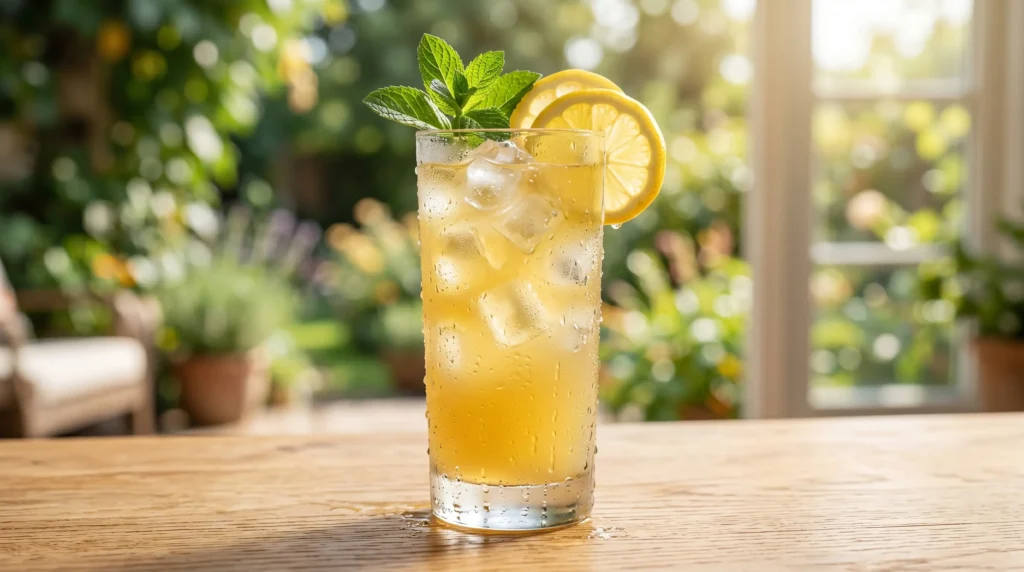
Simple syrup means perfectly even sweetness — every time. Plain sugar stirred into cold water sinks and settles. Some sips are too sweet. Others are not. Simple syrup is just sugar and water heated together until fully dissolved — then cooled. Every sip of your lemonade tastes exactly like the last one.
The lemon zest changes the entire flavor profile. Lemon juice provides tartness from citric acid. Lemon zest provides aroma from limonene — a volatile terpene oil found in the peel. Most recipes use only juice. Adding zest strips to the warm syrup extracts those aromatic oils and gives your homemade lemonade recipe a depth of flavor that juice alone simply cannot produce. It is the difference between tasting lemon and smelling lemon at the same time.
5 minutes of actual work. Simple syrup: 5 minutes. Juicing the lemons: 5 minutes. Everything else is combining and chilling.
Scales to any size. One glass. One pitcher. Party batch for 20 people. Same ratio — just multiply.
Customizable in every direction. Strawberry. Lavender. Mint. Sparkling. Sugar-free. All variations below.
A Quick History — How Lemonade Became America’s Summer Drink
Lemonade has ancient roots. Arab traders were making a sweetened lemon drink called qatarzimat as early as the 10th century. The lemon itself — Citrus limon — is native to South Asia, first cultivated in Assam and northern Burma. It reached the Mediterranean through Arab traders around 1000 CE and arrived in the Americas with Columbus on his second voyage in 1493. In the United States, lemonade became a symbol of summer simplicity — front yard stands, county fairs, and paper cups at baseball games. For the full botanical history of Citrus limon, Britannica’s guide to the lemon plant is worth a few minutes.
The Science: Why This Homemade Lemonade Recipe Tastes Different
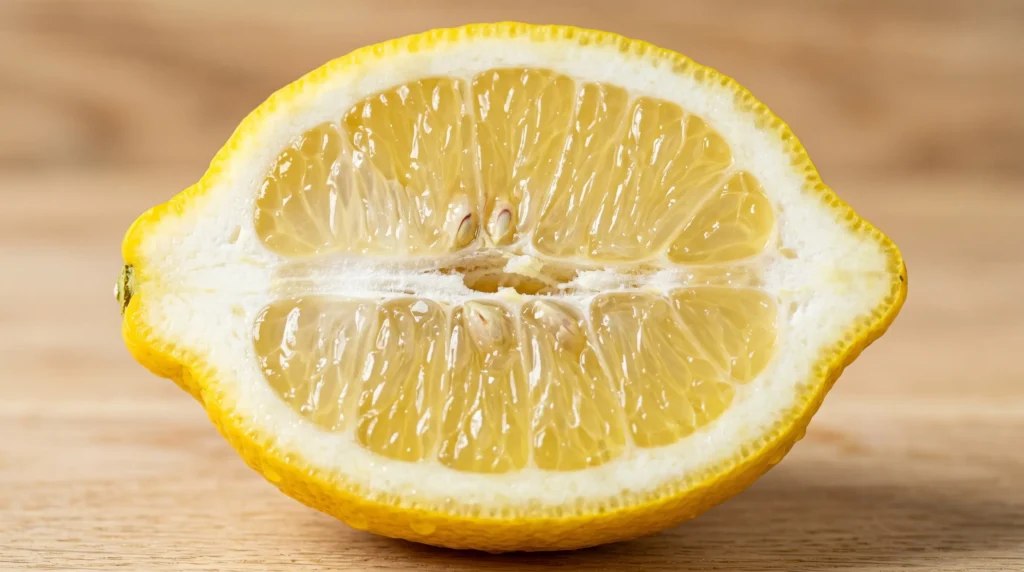
Why citric acid makes your mouth water — literally. Lemon juice contains approximately 5–8% citric acid, giving it a pH between 2.0 and 2.6. Citric acid is a powerful trigger for salivary gland stimulation — your mouth literally produces more saliva in response to the acidity. That is the “ahhh” feeling after the first cold sip on a hot day. The increased saliva creates a sensation of moisture that your brain registers as refreshing. Plain water does not trigger this. Lemonade does — because of the acid.
Why plain sugar does not dissolve properly in cold water. Sucrose dissolves much more slowly in cold water than in hot. Stirring granulated sugar into cold lemon water means only a portion dissolves — the rest settles at the bottom. The result is inconsistent sweetness and a slightly gritty texture in every sip. Heating sugar with equal parts water causes sucrose to fully hydrate and disperse — and partially invert into glucose and fructose, which are slightly sweeter per gram than sucrose alone. A cooled simple syrup distributes instantly and evenly through cold liquid.
Why zest gives you MORE lemon flavor than extra juice. What we perceive as “lemon flavor” is a combination of tartness from citric acid AND aroma from terpene compounds in the peel — primarily limonene. These are fat-soluble and heat-activated, not water-soluble. Squeezing more juice extracts more acid but almost none of those aromatic compounds. Steeping zest strips in warm syrup draws those oils out and infuses them in. You get citric acid from the juice AND limonene aroma from the zest. The lemonade tastes like the whole lemon — not just its acid.
Why fresh beats bottled — every time. Bottled lemon juice has been pasteurized — heat-processed to extend shelf life. That heat degrades the volatile aromatic compounds responsible for fresh lemon’s complexity. Fresh juice also contains vitamin C, flavonoids, and trace minerals that contribute to flavor depth. According to USDA nutritional data for fresh lemon juice, fresh juice contains significantly more bioactive compounds than processed equivalents.
Lemon Variety Guide — Which One to Use
| Lemon Type | Flavor | Juice Yield | Best For |
|---|---|---|---|
| Eureka | Classic tart, bright | High | Everyday lemonade — most common in US |
| Lisbon | Very tart, slightly sharper | High | Extra tartness lovers |
| Meyer | Sweet, floral, less tart | Medium | Milder, sweeter version — great for kids |
| Organic (any) | More aromatic zest | Varies | Always use organic when using the zest |
Key tip: When using the zest — which this recipe does — always choose organic lemons. Conventional lemons are coated with food-grade wax and sometimes treated with post-harvest fungicides. Organic zest is clean, fragrant, and completely safe.
What You Need
For the Lemon Simple Syrup
- 1 cup (200g) granulated white sugar
- 1 cup (240ml) water
- 3–4 strips lemon zest (from 1 organic lemon — vegetable peeler, avoid white pith)
For the Lemonade
- 1 cup (240ml) freshly squeezed lemon juice (about 5–7 lemons)
- 3–4 cups (720–960ml) cold water (adjust to taste)
- 1 cup lemon simple syrup (from above)
- ¼ tsp salt (the professional trick — see Expert Touch)
- Ice cubes — generous, in glasses only
- Lemon slices + fresh mint for garnish
Equipment: Small saucepan, citrus juicer or citrus press, large pitcher, fine mesh strainer, vegetable peeler Makes: 1 large pitcher — serves 4–6
How to Make This Homemade Lemonade Recipe — Step by Step
Step 1 — Make the Lemon Simple Syrup
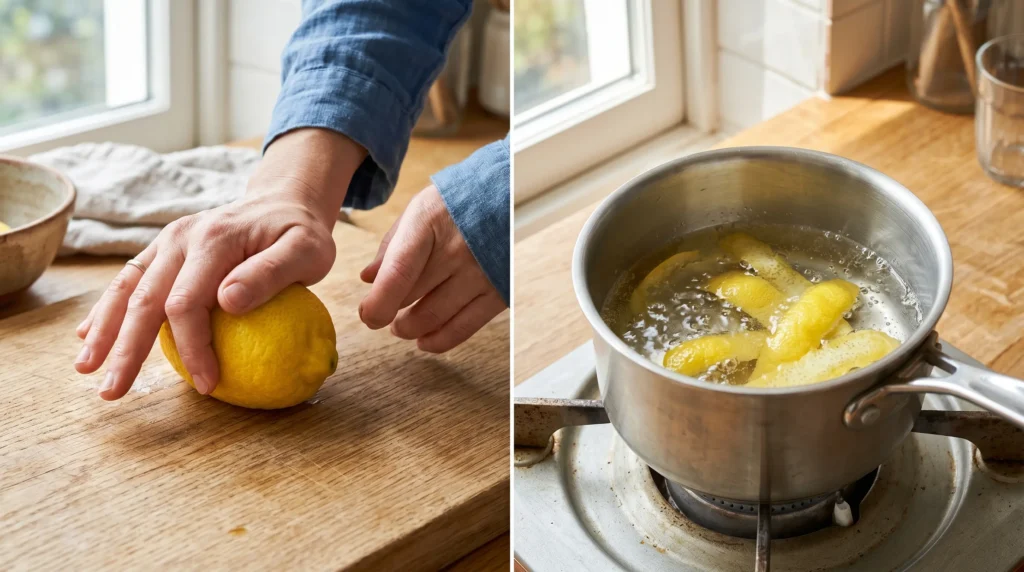
Combine sugar and water in a small saucepan over medium heat. Stir until sugar begins dissolving. Add lemon zest strips. Bring to a gentle simmer and stir until all sugar is completely dissolved — about 3–4 minutes. Remove from heat. Let zest steep in the warm syrup for 10 minutes — this is when the limonene extracts.
Strain through a fine mesh sieve. Cool completely before using — 30 minutes at room temperature or 15 minutes in the refrigerator.
J.ZaiB micro-tip: Use a vegetable peeler for wide zest strips, not a fine grater. Wide strips give more surface area for aromatic oil extraction without releasing bitter pith compounds. Avoid the white layer beneath the yellow skin entirely — pure bitterness.
Step 2 — Roll and Juice the Lemons
Before cutting, place each lemon on the counter and press firmly with your palm while rolling for 15–20 seconds. This ruptures the internal juice vesicles — tiny pockets holding the juice inside — making each lemon release 20–30% more juice than cutting straight.
Cut in half and juice using a citrus juicer. Strain through a fine mesh sieve to remove seeds and pulp.
J.ZaiB micro-tip: Room temperature lemons yield more juice than cold ones. If your lemons came straight from the fridge, microwave for 15 seconds first. Not hot — just room temperature.
Step 3 — Combine and Taste
In a large pitcher, combine fresh lemon juice and cooled simple syrup. Stir together. Add 3 cups of cold water and the salt. Stir well.
Taste carefully. Too tart? Add more syrup. Too sweet? Add more lemon juice or water. Tastes one-dimensional? Check the salt — it is probably missing.
J.ZaiB micro-tip: My first properly made batch was still slightly off — the lemons that day were less tart than usual and the balance was wrong. An extra half teaspoon of lemon juice fixed it immediately. Always taste before serving. Every batch of lemons is slightly different and requires a small final adjustment.
Step 4 — Chill and Serve
Add ice to individual glasses — not the pitcher. Pour lemonade over ice. Garnish with thin lemon slices and fresh mint. Serve immediately.
J.ZaiB micro-tip: Chill your glasses in the freezer for 5 minutes before serving. A frosted glass keeps lemonade cold significantly longer and looks dramatically more impressive for guests.
Sweetness Guide — Find Your Perfect Level
| Level | Simple Syrup | Water | Lemon Juice | Result |
|---|---|---|---|---|
| Tart | ½ cup | 4 cups | 1 cup | Sharp, bright — classic diner style |
| Balanced | ¾ cup | 3½ cups | 1 cup | This recipe default |
| Sweet | 1 cup | 3 cups | ¾ cup | Great for kids |
| Extra sweet | 1¼ cups | 2½ cups | ½ cup | Dessert-style — serve over shaved ice |
J.ZaiB’s Expert Touch
Make a double batch of simple syrup and refrigerate it. Lemon simple syrup keeps for up to 3 weeks in a sealed jar. With it ready, a fresh pitcher of homemade lemonade takes literally 2 minutes — squeeze lemons, add syrup, add water. This is exactly how restaurants produce consistent lemonade every service.
Grate fresh zest directly over the finished pitcher. After assembling, fine-grate one more lemon’s zest over the top of the pitcher. The fresh oils bloom on the surface — every glass poured gets a burst of fresh lemon aroma before the first sip. The difference between lemonade with and without fresh surface zest is immediately noticeable.
The salt trick changes everything. A quarter teaspoon of fine salt per pitcher suppresses bitterness, amplifies sweetness, and makes the tartness feel cleaner and brighter. Professional bartenders call this “seasoning the drink.” The lemonade will not taste salty — it will taste more intensely like lemonade. Try it once and you will never skip it.
Mint goes in last, not first. Adding mint early and letting it sit makes the lemonade taste slightly grassy and medicinal as the oils oxidize. Add fresh mint right before serving, or muddle 3–4 leaves gently in the bottom of individual glasses.
For parties — concentrate, not pitcher. Make triple the simple syrup. Combine with lemon juice (no water). Refrigerate the concentrate. At the party, guests pour concentrate over ice and top with water themselves — no dilution from sitting ice, maximum freshness, everyone adjusts to their own taste.
Variations to Try
Strawberry Lemonade: Blend 1½ cups fresh strawberries until smooth, strain through a sieve, add 1 cup of puree to the finished pitcher. The deep pink color is stunning and the flavor combination is summer’s best. Our Best Fresh Strawberry Pie alongside a glass of this is one of the most complete summer pairings on the site.
Lavender Lemonade: Add 2 tablespoons dried culinary lavender to the simple syrup with the zest. Steep 10 minutes alongside, then strain. The floral, elegant note transforms standard lemonade into something genuinely sophisticated. Serve with a fresh lavender sprig in each glass.
Sparkling Lemonade: Make the concentrate (lemon juice + syrup, no water). At serving time, pour over ice and top with chilled sparkling water individually — never mix the full pitcher ahead. CO2 dissipates rapidly in acidic lemonade — individual glasses at the last second only.
Mint Lemonade (Lebanese Style): Blend 1 cup fresh mint with the lemon juice before adding to the pitcher. Strain. Bright green, intensely minty, genuinely refreshing on a hot day.
Ginger Lemonade: Add 2 tablespoons freshly grated ginger to the simple syrup with the zest. Steep and strain. The warming spice note makes this work in cooler weather too. If you enjoy spiced syrup techniques, our Pumpkin Spice Latte uses a very similar spice-infused syrup method.
Sugar-Free Lemonade: Make simple syrup with monk fruit sweetener or allulose at the same 1:1 ratio with water. Both dissolve cleanly without bitter aftertaste. Stevia works but leaves a competing bitter note.
Lemonade Bar (Party Format): Make a large batch of concentrate. Set out still and sparkling water, the concentrate, and mix-in options: strawberry puree, mint, lavender syrup, ginger syrup. Guests build their own — completely customizable and guaranteed to be the most talked-about part of any gathering. Similar interactive format to our New Year’s Eve Party Menu approach applied to summer entertaining.
Serving Ideas
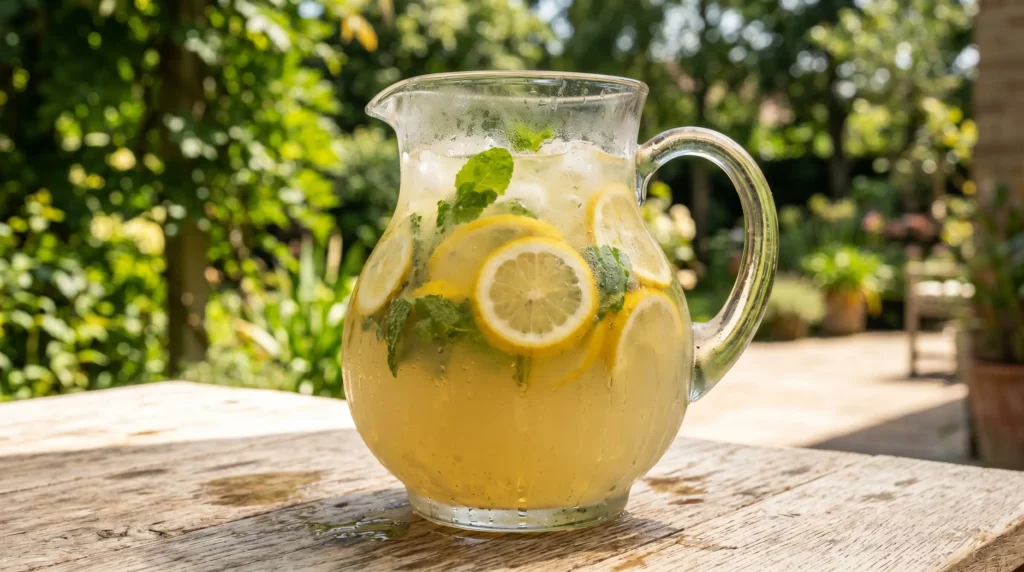
BBQ and outdoor parties: Make the concentrate up to 3 days ahead. At the event, set out with pitchers of ice water — guests mix their own glasses. No dilution, no last-minute rushing, maximum freshness.
Kids’ summer treat: Strawberry variation in deep pink — serve in clear plastic cups. Add a paper straw and a lemon slice on the rim.
Summer dinner pairing: Lemonade’s citric acid cuts through the fat of grilled and fried food beautifully. Serve alongside our Best Italian Meatballs for a simple summer dinner. For a complete summer drinks spread, pair with our Mango Lassi — two completely different flavor profiles that together cover every preference.
Storage Guide
Finished lemonade: Refrigerate in a covered pitcher up to 3 days. Remove ice before storing — melting ice dilutes. Re-stir before serving.
Lemon simple syrup: Sealed jar in refrigerator up to 3 weeks. The zest makes it slightly more perishable than plain syrup — check for cloudiness or off smell after 2 weeks.
Fresh squeezed lemon juice: Refrigerate up to 3–4 days. Freeze in ice cube trays up to 3 months — each cube is approximately 2 tablespoons.
Make-ahead party timeline:
- Up to 3 weeks before: Make simple syrup, refrigerate
- Up to 3 days before: Squeeze and refrigerate lemon juice
- Up to 24 hours before: Combine juice + syrup + water, refrigerate
- At serving: Add ice to glasses, garnish fresh
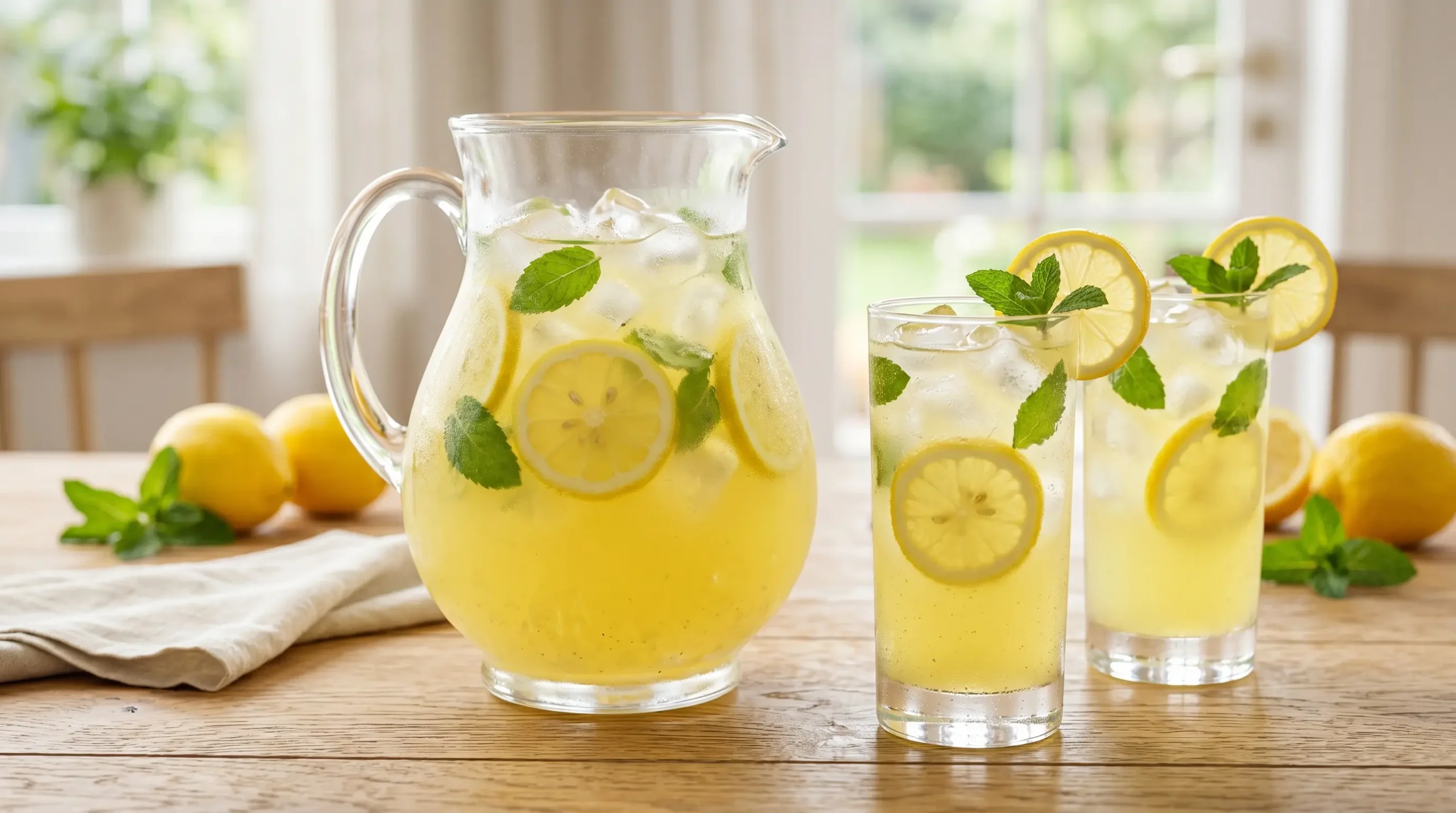
Best Homemade Lemonade Recipe
Ingredients
Equipment
Method
- Combine sugar and water in a small saucepan over medium heat. Stir to begin dissolving. Add lemon zest strips. Bring to a gentle simmer, stirring until all sugar is completely dissolved — about 3–4 minutes. Remove from heat. Let zest steep 10 minutes.

- Strain through a fine mesh sieve. Cool completely before using — 30 minutes at room temperature or 15 minutes in the refrigerator.
- Roll each lemon firmly on the counter with your palm for 15–20 seconds before cutting. This ruptures the internal juice vesicles and increases yield by 20–30%. Cut in half and juice using a citrus juicer. Strain through a fine mesh sieve to remove seeds.
- In a large pitcher, combine fresh lemon juice and cooled simple syrup. Stir. Add 3 cups of cold water and the salt. Stir well. Taste — add more water for lighter, more syrup for sweeter, more juice for more tart. Adjust until balanced.
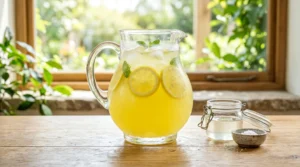
- Add ice to individual glasses — not the pitcher. Pour lemonade over ice. Garnish with lemon slices and fresh mint. Serve immediately.

Notes
- Always fresh lemon juice — never bottled. Pasteurized bottled juice has lost its volatile aromatic compounds. The flavor difference is immediately and clearly noticeable.
- Organic lemons for zest. Always use organic when using the peel — conventional lemons may have wax or fungicide residues.
- Roll lemons before juicing — increases yield 20–30%. Room temperature lemons yield more than cold — microwave 15 seconds if from the fridge.
- Simple syrup keeps 3 weeks refrigerated in a sealed jar. Make a double batch for convenient everyday lemonade.
- Ice in glasses only — not the pitcher. Melting ice dilutes the lemonade. Add ice to individual glasses at serving time.
- Salt is non-negotiable. ¼ tsp per pitcher suppresses bitterness and amplifies sweetness + tartness perception. Lemonade will not taste salty — it tastes more intensely like lemonade.
- Sweetness guide: Tart: ½ cup syrup + 4 cups water. Balanced (default): ¾ cup syrup + 3½ cups water. Sweet: 1 cup syrup + 3 cups water. Extra sweet: 1¼ cups syrup + 2½ cups water.
- Sugar-free version: Use monk fruit sweetener or allulose at same 1:1 ratio with water. Both dissolve cleanly. Avoid stevia — bitter aftertaste.
- Sparkling version: Add chilled sparkling water to individual glasses right before serving — never to the pitcher. CO2 dissipates rapidly in acidic lemonade.
- Strawberry lemonade: Blend 1½ cups fresh strawberries, strain, add 1 cup puree to finished pitcher.
- Lavender lemonade: Add 2 tbsp dried culinary lavender to syrup with zest. Steep and strain.
- Ginger lemonade: Add 2 tbsp freshly grated ginger to syrup with zest. Steep and strain.
- UK/Australia notes: “Granulated sugar” = caster sugar works. “Pitcher” = jug. “Citrus press” = lemon squeezer.
- Nutrition values are estimates based on balanced sweetness level. Actual values vary by exact syrup quantity and serving size.
NUTRITION
(Per 1 glass — based on 5 servings, balanced sweetness)
| Nutrient | Amount |
|---|---|
| Calories | ~120 kcal |
| Total Fat | 0g |
| Saturated Fat | 0g |
| Cholesterol | 0mg |
| Sodium | 60mg |
| Total Carbs | 32g |
| Sugars | 30g |
| Fiber | 0g |
| Protein | 0g |
Note: Values are estimates. Actual values vary based on syrup quantity used and serving size.
Frequently Asked Questions
Why does my homemade lemonade taste flat?
Usually one of three reasons: bottled juice instead of fresh (no aromatic compounds), plain sugar instead of simple syrup (inconsistent sweetness), or no zest in the syrup. Together — fresh juice + zest-infused syrup + a pinch of salt — these three create the depth and balance that makes lemonade genuinely complex. If you did all three and it still tastes flat, add more lemon juice. Most people underestimate how much tartness good lemonade needs.
How many lemons do I need for this Homemade Lemonade Recipe?
One medium lemon yields approximately 2–3 tablespoons (30–45ml) of juice. For 1 cup (240ml) of fresh lemon juice, you need about 5–7 lemons. Rolling them before juicing and using room-temperature lemons increases yield noticeably. Meyer lemons yield slightly less juice but have a sweeter flavor.
Can I make lemonade without simple syrup?
You can — but expect undissolved granules and inconsistent sweetness. A workaround: dissolve sugar in the fresh lemon juice first before adding water. Citric acid helps dissolve sugar faster than plain cold water. Better than straight into the pitcher but still not as good as properly made simple syrup.
How long does homemade lemonade last in the fridge?
Up to 3 days in a sealed pitcher. After that, the lemon juice oxidizes and loses its fresh flavor — still safe to drink but noticeably duller. Remove ice before refrigerating to prevent dilution.
Can I make sugar-free homemade lemonade?
Yes — make simple syrup with monk fruit sweetener or allulose in the same 1:1 ratio with water. Both dissolve cleanly without bitter aftertaste. The result is genuinely close to the original in flavor and texture.
Why does my sparkling lemonade go flat immediately?
CO2 dissipates very rapidly in acidic environments. Always add sparkling water to individual glasses right before serving — never to the pitcher in advance. Make a concentrate (juice + syrup only) and pour sparkling water over ice in each glass at the moment of serving.
What is the best lemon for homemade lemonade?
Eureka and Lisbon are the standard supermarket varieties — both work well for everyday lemonade. Meyer lemons are sweeter and more floral — excellent for a milder version. For best zest results, always use organic — conventional peel may have wax or fungicide residues.
What is the ratio of lemon juice to water for lemonade?
Standard balanced ratio: approximately 1 part lemon juice to 3–4 parts water, sweetened with simple syrup to taste. For more intense: 1:3. For lighter: 1:4 or 1:5. Always taste and adjust — lemon acidity varies between batches and varieties.
The Five-Minute Drink That Defines Summer
Every summer deserves a Homemade Lemonade Recipe you can make any afternoon without thinking. This one — zest-infused simple syrup, fresh squeezed juice, a pinch of salt, and ice cold water — is exactly that. Simple enough for a Tuesday afternoon, impressive enough for a party table.
The citric acid will make your mouth water on the first sip. The limonene from the zest will hit your nose before the glass reaches your lips. The simple syrup will make every sip taste exactly like the first one.
That is everything a lemonade should be.
Tag us on Instagram @viralfoodhacks706 when you make a pitcher — the strawberry version photos are always stunning! Save this to Pinterest so it is always ready when the first hot day of summer arrives.