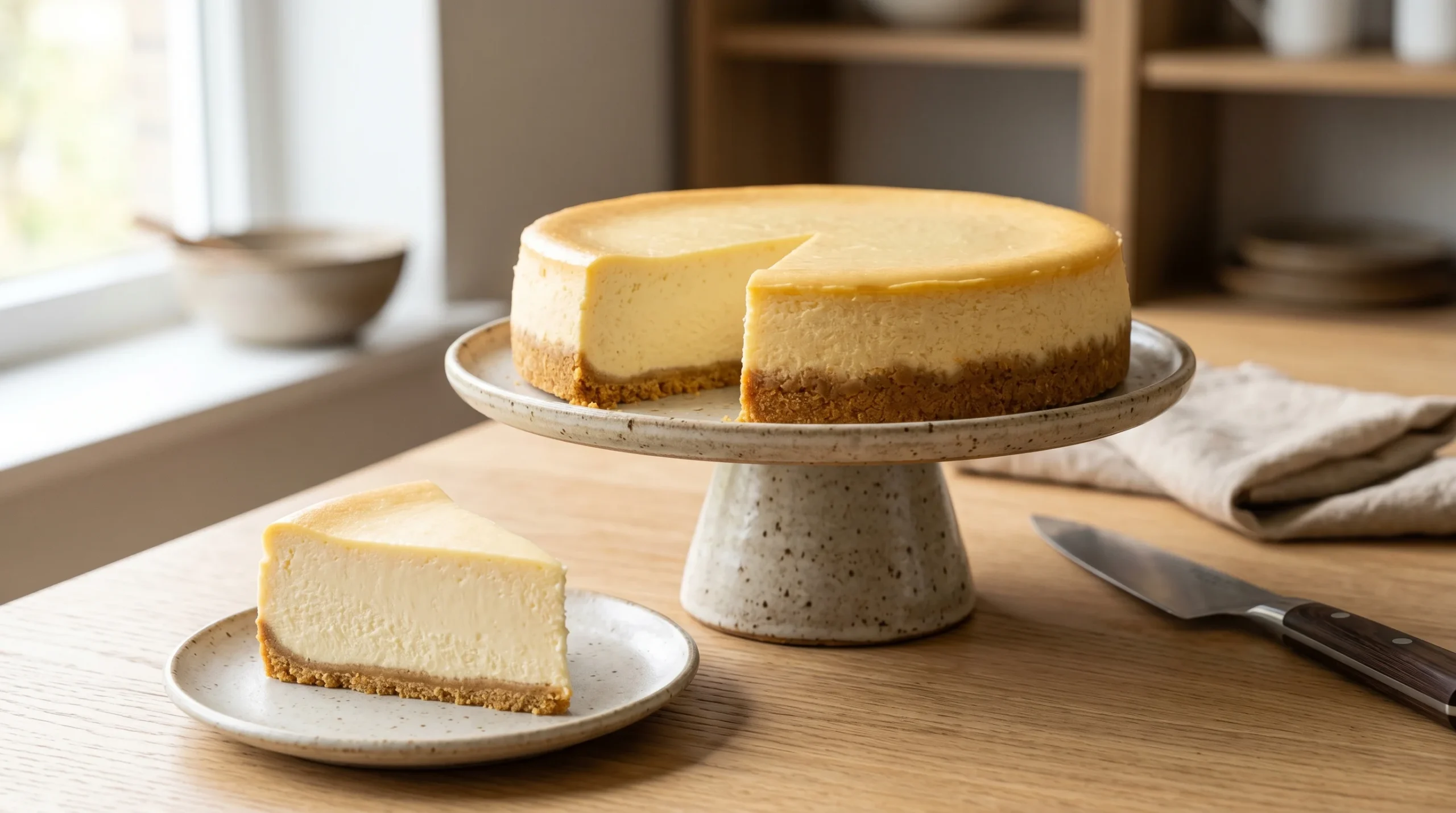
Ingredients
Equipment
Method
Prep
- Take cream cheese, sour cream, heavy cream, and eggs out of the fridge at least 1 hour before starting. Room temperature ingredients are essential — cold cream cheese creates lumps that require overmixing to fix, which adds air, which causes cracks.
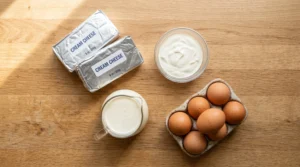
Make the Crust
- Preheat oven to 325°F (165°C). Pulse graham crackers in a food processor to fine, even crumbs. Mix with sugar, melted butter, and salt until the mixture clumps when pressed.
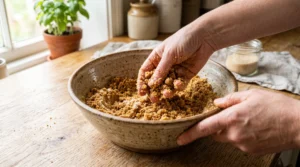
- Press firmly into the bottom of the springform pan and about 1 inch up the sides. Use the flat bottom of a measuring cup to compact evenly. Bake 8 minutes. Remove and cool completely before adding filling.
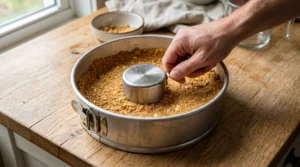
Set Up the Steam Hack
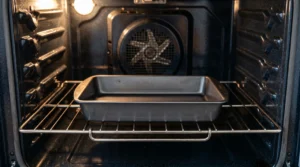
- Place an empty metal baking pan on the lowest oven rack. This is where you will pour boiling water just before putting the cheesecake in. Do not use glass — it can shatter from sudden heat.
Make the Cheesecake Filling
- Beat room temperature cream cheese in a stand mixer on MEDIUM speed for 2 minutes until completely smooth and lump-free. Add sugar and cornstarch, beat 1 minute on medium. Scrape down the sides of the bowl.
- Add sour cream, heavy cream, vanilla bean paste, and lemon zest. Mix on LOW speed until just combined — about 20 seconds. Scrape the bowl again.

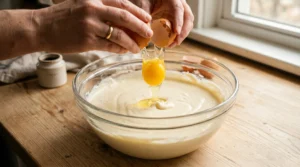
- Add eggs one at a time on LOW speed, mixing only until each egg disappears before adding the next. Add egg yolk last. Stop the mixer the moment it is incorporated. Do not mix further.
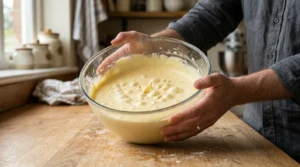
- Tap the bowl firmly on the counter 20 times to pop surface air bubbles. Let sit 5 minutes, then tap 10 more times.
Bake
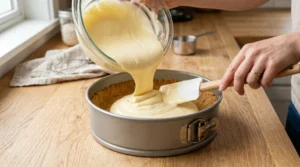
- Pour filling over the cooled crust. Smooth the top gently with an offset spatula. Tap the pan 5 times on the counter to settle any remaining bubbles.
- Boil a full kettle of water. Place cheesecake on the CENTER oven rack. Immediately pour 2 cups of boiling water into the empty metal pan on the LOWER rack. Close the oven door quickly.
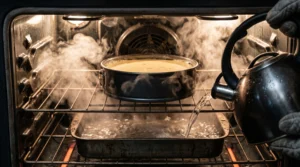
- Bake at 325°F (165°C) for 55–65 minutes. The cheesecake is done when the outer 2 inches are completely set and still, and the center 3 inches wobble gently as one mass when you nudge the pan — like set Jell-O. Start checking at 55 minutes. If your oven runs hot, start checking at 50 minutes.
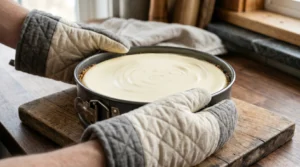
Cool Down
- Turn off the oven. Crack the door open about 1 inch — prop with a wooden spoon. Leave the cheesecake inside for exactly 1 hour. Do not open wider or move the cheesecake during this time.
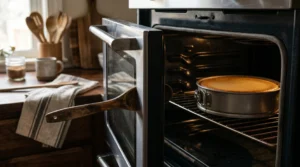
- Remove from oven. Immediately run a thin knife all the way around the inside edge of the pan. Let cool completely at room temperature — about 1 more hour.
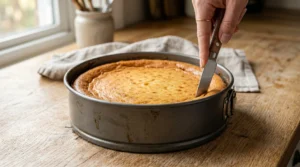
Add Topping and Chill
- Mix sour cream, powdered sugar, and vanilla extract until smooth. Spread in a thin, even layer over the completely cooled cheesecake.
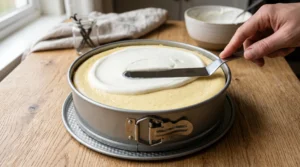
- Cover loosely with plastic wrap. Refrigerate for a minimum of 8 hours — overnight is best, 2 days gives peak flavor and texture.
Serve
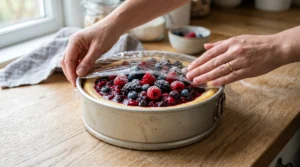
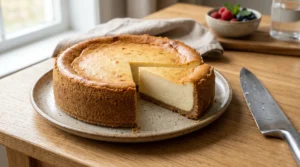
- Run a knife around the edge one more time. Release and remove the springform sides. Slice with a sharp knife dipped in hot water and wiped completely dry between every cut. Serve cold, directly from the refrigerator.
Notes
NOTES
- Block cream cheese only — not tub. Tub or spreadable cream cheese has more water and stabilizers. It produces a softer filling that won't hold its shape when sliced. Four full 8-oz blocks of full-fat Philadelphia brand cream cheese is the standard for a reason.
- Why cornstarch? Cornstarch stabilizes the egg proteins in the filling, keeping them flexible during baking instead of contracting and cracking. Do not substitute with flour 1:1 — cornstarch has twice the thickening power. If using flour, use 5 tablespoons instead of 3.
- Room temperature is non-negotiable. Cold cream cheese creates lumps. Lumps mean more mixing. More mixing means more air. More air means more cracks. One hour minimum out of the fridge.
- The jiggle test. The center should wobble gently as ONE mass — not slosh like liquid (underdone) and not be completely rigid (overbaked). This is the most reliable doneness indicator for cheesecake.
- Oven variation. If your oven runs hot, reduce temperature to 310°F (155°C) and add 5–8 minutes to baking time. An oven thermometer is the best $10 investment for cheesecake baking.
- Steam hack — metal pan only. Glass pans can shatter when you pour boiling water into them in a hot oven. Use aluminum or steel.
- Edge browning is normal. The top edge may brown slightly during baking. The sour cream topping covers this completely. Do not open the oven to check on it — the temperature drop can cause cracking.
- No buttermilk? This recipe does not use buttermilk — the sour cream provides the tangy flavor and some acidity. No substitution needed.
- Gluten-free crust: Replace graham cracker crumbs with 2 cups almond flour mixed with 3 tbsp melted butter, 2 tbsp sugar, and a pinch of salt. Press and bake exactly the same way.
- Keto version: Use the almond flour crust above and replace granulated sugar in the filling with 1 cup powdered erythritol or monk fruit sweetener.
- UK/Australia notes: "Graham crackers" = digestive biscuits (reduce butter slightly). "Heavy whipping cream" = double cream. "Powdered sugar" = icing sugar. "Sour cream" = same in most regions; crème fraîche works as a substitute.
- Storage — Refrigerator: Up to 5 days tightly covered. Best at 24–48 hours. Always serve cold. Freezer (slices): Wrap individually in plastic wrap and foil, freeze up to 2 months. Thaw overnight in fridge. Freezer (whole): Freeze uncovered 2 hours until firm, wrap tightly, freeze up to 2 months.
- Make-ahead: Bake 2 days ahead, refrigerate without topping. Add sour cream topping the day before serving. Slice and garnish day of.
- Nutrition values are estimates. Use a nutrition calculator with your exact brands for precise figures.