
Ingredients
Equipment
Method
Day 1 Evening - Make the Dough
- Mix Until Smooth, Then Chill: Combine flour, salt, sugar, and yeast in the stand mixer bowl. Add cold milk and mix on low for 2 minutes. Add the softened butter and mix on medium for 5 to 7 minutes until the dough is smooth and slightly tacky but not sticky. Do not overmix since this generates heat that warms the dough. Shape into a flat rectangle about 1 inch thick, wrap tightly in plastic wrap, and refrigerate overnight for at least 8 hours.

Day 2 Morning - Make the Butter Block
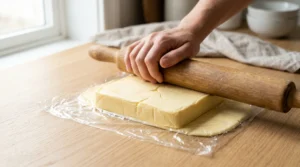
- Pound Into a Pliable Square: Place the cold European butter between two sheets of plastic wrap. Using a rolling pin, pound it into a 7-inch by 7-inch square of even thickness. The butter should be cold and firm but bend slightly without cracking. If it cracks, it is too cold. Let it sit for 5 minutes and try again. If it is soft and greasy, refrigerate for 10 minutes. The correct butter temperature is around 60°F (15°C).
Encase the Butter in the Dough
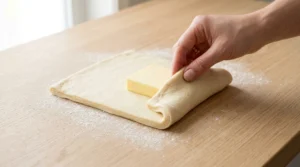
- Seal All Four Edges: Roll the refrigerated dough into a 14-inch by 8-inch rectangle on a lightly floured surface. Place the butter square in the center. Fold the dough edges over the butter like an envelope, sealing all four sides by pressing firmly. Pinch every seam closed so no butter is exposed.
Three Letter Folds
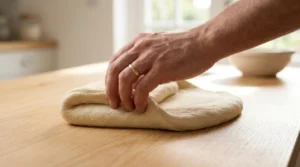
- First Fold: Roll the dough into a 24-inch by 8-inch rectangle using long, even strokes. Fold into thirds like a letter (bottom up to center, top down over it). Wrap and refrigerate 30 minutes.
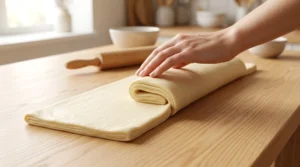
- Second Fold: Remove dough, rotate 90 degrees so the open edge faces you. Roll out and fold into thirds again. Wrap and refrigerate 30 minutes.
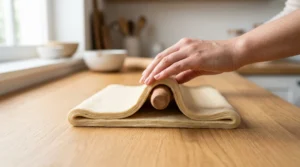
- Third Fold: Repeat one final time. After the third fold, the dough has over 27 butter layers. Wrap tightly and refrigerate overnight.
Day 3 Morning - Shape the Croissants
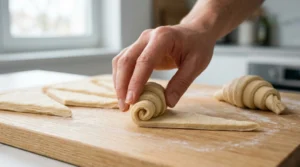
- Roll Thin, Cut Triangles, Roll Into Crescents: Remove the laminated dough and let rest at room temperature for 5 minutes until barely pliable. Roll into a rectangle approximately 20 inches by 10 inches and 3 millimeters thick. Cut into triangles with a 4-inch base and 8-inch height. Make a small 1-centimeter cut at the center of each triangle's base. Gently stretch each triangle slightly. Roll from the base toward the tip with firm, even tension. Tuck the tip underneath and bend the ends to form the crescent shape. Place on parchment-lined baking sheets with the tip underneath.
First Egg Wash
- Brush Lightly, Avoid the Cut Edges: Whisk the egg, milk, and salt together. Brush each shaped croissant with a light coat, avoiding the exposed cut layers at the ends. Refrigerate for 15 minutes to set.

Proof
- Room Temperature Only, Watch for the Wobble: Proof in a spot below 77°F (25°C) for 2 to 3 hours. The croissants are ready when they look visibly puffed and wobble gently like soft gelatin when you shake the pan. Never proof in a warm oven since the butter layers will melt.

Second Egg Wash and Bake
- Second Coat, Then Hot Oven: Preheat oven to 400°F (200°C). Brush with a second light coat of egg wash. Bake for 18 to 22 minutes until deep golden brown all over including the bottoms. Cool on a wire rack for 10 minutes before eating.

Notes
- Kitchen scale is essential. Croissants require precise measurements. Do not use volume measures for this recipe.
- European butter only. Minimum 82 percent fat content. Plugra, Kerrygold, or Lurpak are widely available. Higher fat, lower water content keeps layers distinct during lamination and produces a richer flavor.
- Cold is everything. Refrigerate the dough between every fold. If at any point the butter feels soft or the kitchen is warm, stop and refrigerate before continuing.
- 3-day timeline is recommended. Day 1 evening: dough. Day 2: lamination. Day 3 morning: shape, proof, bake. This produces the best flavor and layer development.
- The wobble test. Properly proofed croissants wobble like gelatin when the pan is gently shaken. Too firm means under-proofed. Collapsed or over-expanded means over-proofed.
- Double egg wash. Applying egg wash twice, once before the refrigerator rest and once before baking, creates the deep, even golden color of professional croissants.
- Troubleshooting: Dense interior means butter merged into dough. Butter leaking means too soft when encased. No rise means over-proofed or under-proofed.
- Freezing unbaked: Shape, freeze on a tray until solid, bag and freeze up to 1 month. Night before baking: thaw in fridge, then room temperature proof until wobble test passes.
- Reheating day-old croissants: Sprinkle lightly with water and heat in a 350°F oven for 5 to 7 minutes. Refreshes the layers dramatically.
- UK/Australia notes: "Bread flour" equals strong flour. "European-style butter" is sold as cultured butter or high-fat butter. "All-purpose flour" equals plain flour (but bread flour preferred here).
- Nutrition values are estimates and vary based on exact butter quantity and croissant size.